

This post may contain affiliate links. When you purchase something through these links, I receive a small commission that helps me create this blog’s content. There’s no extra cost to you. Read my privacy policy to learn more.
Published 10/10/2022
Everything You Need to Know About White Sands National Park Sledding
Believe it or not, sledding is one of the most popular activities at White Sands National Park in New Mexico. Other than spending some time in Santa Fe, sledding at White Sands National Park was the only must-do item on my New Mexico itinerary.
But I struggled to find the nitty gritty (forgive the pun) details on how to do this. In this post I’ll outline everything you need to know so you can take a few spins down the White Sands dunes.
Where Is White Sands National Park?
You’ll find White Sands outside Alamogordo, New Mexico in the Tularosa Basin. Located in southcentral New Mexico at 4235’, the park sits between two mountain ranges: the Sacramento and San Andres.
Drivetimes to White Sands National Park
Albuquerque, NM to White Sands: 3.5 hours
Carlsbad Caverns National Park to White Sands: 3.5 hours
El Paso, TX to White Sands: 1.5 hours
Tucson, AZ to White Sands: 5 hours
About White Sands National Park

Although it’s one of America’s newest national parks, White Sands has been protected by the National Park Service since in 1933 when it was designated a national monument. In 2019, it got promoted to national park status. You still find an old school “National Monument” sign outside the visitor center.
White Sands is exactly what it sounds like: a large area of white gypsum sand that the wind whips into dunes. Often described as a beach without the ocean, most people come to White Sands National Park to snap pictures, do a little hiking, and maybe slide down a dune or two. With an average high temperature of 78 degrees and less than 10 inches of annual precipitation, you can pretty much plan on “beachy” weather during your visit.
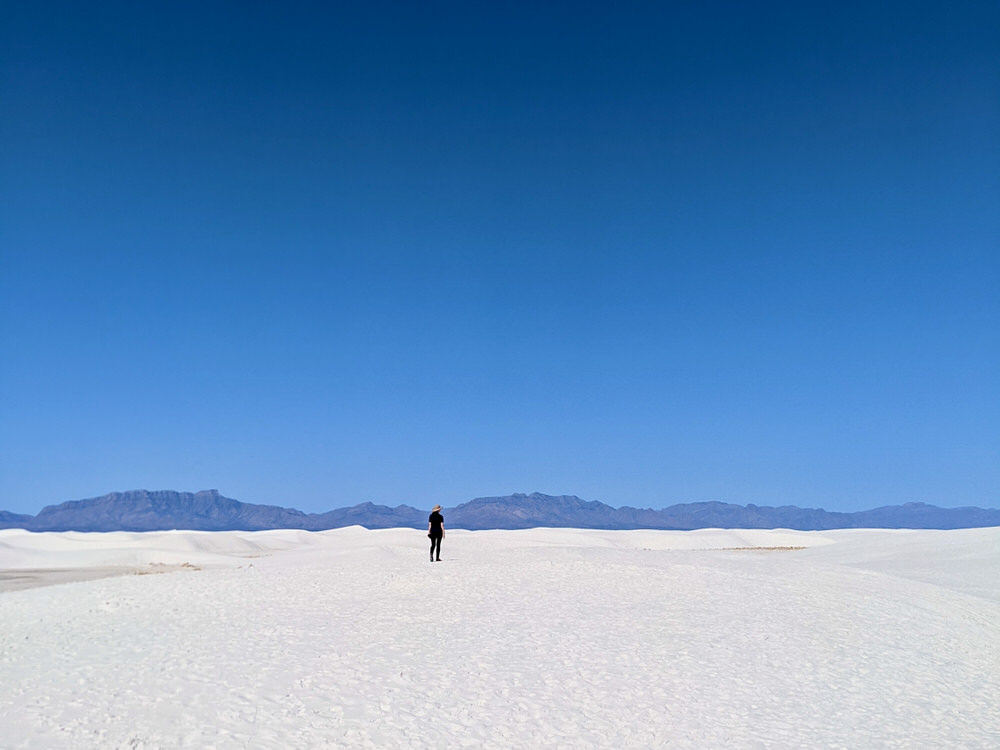 It’s worth noting that White Sands is small. The only road in the park – Dunes Drive – is just eight miles long. Other than the five-mile Alkali Flats hiking trail, you really can’t stray terribly far from the road on any developed trails. Of course, there’s nothing stopping you from straight-up wandering across the sand but that’s really not recommended as it’s very easy to get disoriented in the sandy expanse.
This spectacular spot is definitely a national treasure, but I question if it should have remained a national monument. You certainly shouldn’t expect the same level of activities and amenities that you might get at larger national parks.
Another important note: White Sands Missile Range almost completely engulfs the park. This means some of the land officially in the park is restricted from the public. During missile range tests, the park closes, so it pays to double check that the park will be open during your planned visit.
Why Go Sledding at White Sands
 Sure you can go sand sledding in other parts of the United States like Great Sand Dunes or Indiana Dunes, but what really makes the experience unique at White Sands is the sand itself. The park’s unique white sand is made of gypsum. In both appearance and texture, the sand reminded me of kinetic sand, although it certainly doesn’t clump the same way.
Because gypsum sands have amazing water retention, the sand always feels cool to the touch. It’s lovely underfoot! Even though it’s almost always warm at White Sands, you never need to worry about walking across burning hot sand. This also means you can go sledding on even the hottest day. Just make sure you’ve applied plenty of sunscreen and have lots of water along.
Steps to go Sledding at White Sands National Park
1) Get a sled

First things first, if you want to go sledding at White Sands National Park, you’re going to need a sled. Sure, you could try sliding down the dunes on a sheet of cardboard but you’ll probably be happiest with something a little heftier.
The easiest way to get a sled for White Sands is buying a sledding saucer in the visitor center. You’ll find the sleds in the large gift shop at the back of the visitor center. Although there’s another gift shop in the front room with an information desk, you won’t find any sleds there. You stop at the visitor center before you enter the actual park. If you’ve gone through the pay station, you’ve missed it and will need to turn back to grab sleds.
For liability reasons, you can’t rent a sled from the national park. However, you may be able to purchase a discounted used sled if you ask at the check-out counter. If you only need the sled for your visit to White Sands National Park, you can return your sled on your way out.
Cost of sleds at White Sands National Park
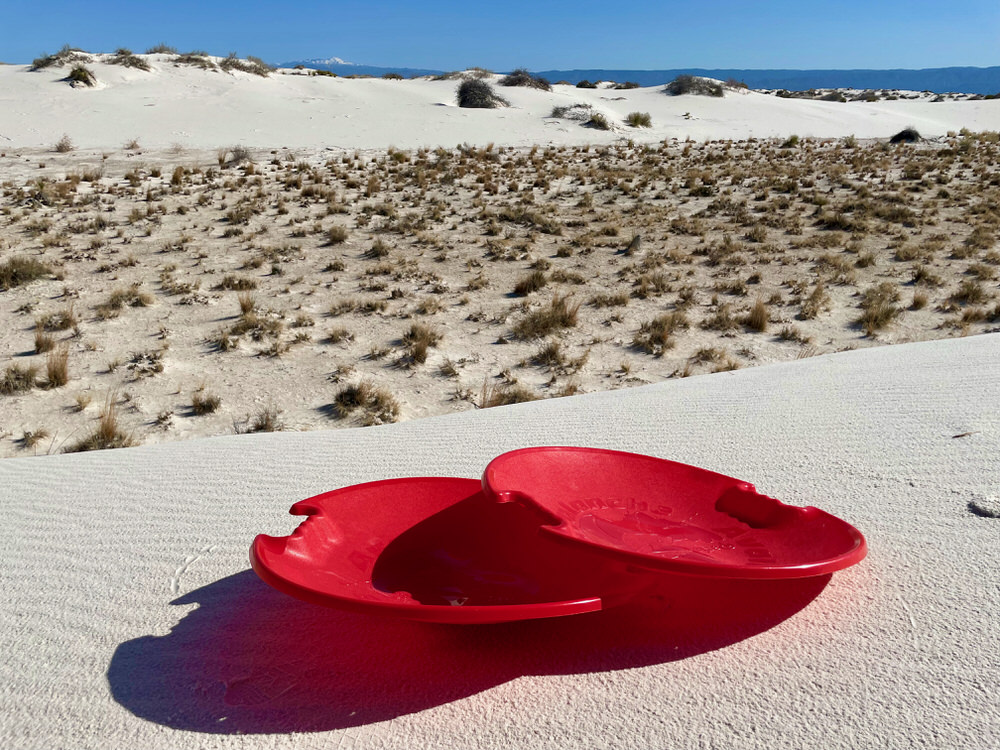 As of March 2022, a new sled cost $25.99 and used sleds cost $16.99 at the White Sands National Park. When we visited, they only had one used saucer available. But when we left, they definitely had at least two used saucers available for the next person in line!
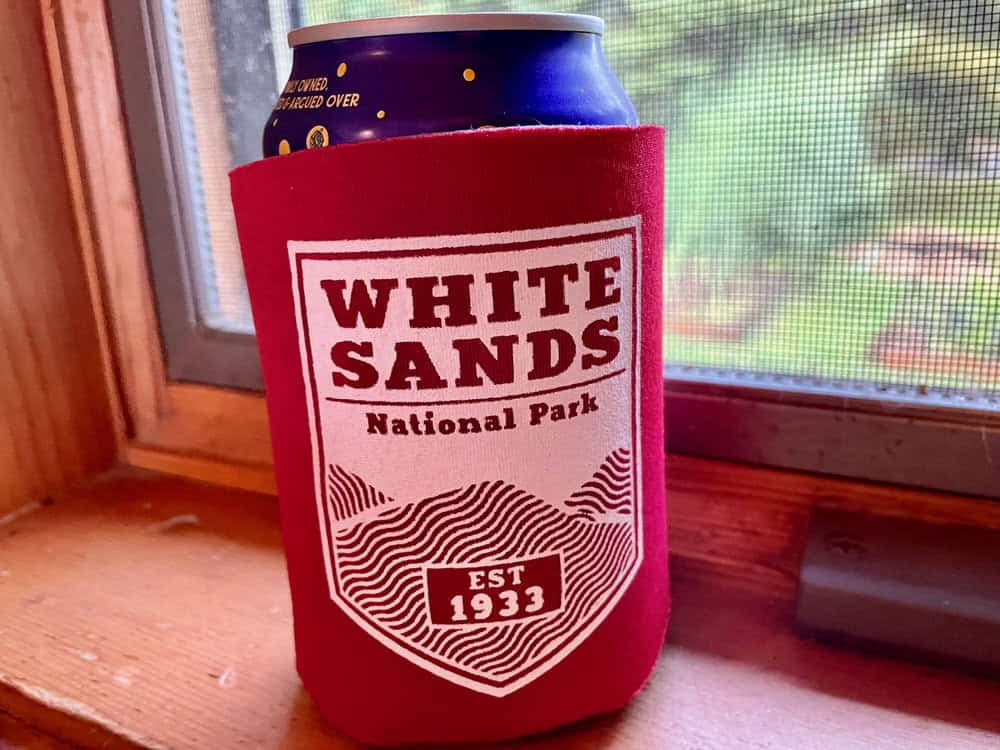
A note on returning your sleds: It’s well publicized that you’ll receive $5 back when you return your sled. But these days, you just get a crappy White Sands can koozie. I understand that this makes end of the day accounting for the park much easier. However, it took a little arm twisting to get two koozies, even though we’d returned two sleds. Let it be known, if you only need a sled for your visit to White Sands National Park, the adventure will cost you at least $17 per sled with the somewhat undesirable option for a free can koozie home to clutter your kitchen drawers until you eventually throw it out in a couple years.
Can you bring your own sled?
Absolutely! We definitely saw people hitting the dunes with small snow sleds. I’m not sure if these oblong sleds pick up as much speed, but no one seemed to be struggling.
The downside to bring your own sled is White Sands’ somewhat out of the way location. You might not be keen to tote a sled around for an entire road trip if it’ll only get used for about 30 minutes at White Sands. Even the small saucers we purchased wouldn’t have fit in my (admittedly very large) suitcase. So whether you like it or not, if you want to go sledding at White Sands National Park, purchasing a sled at the visitor center is often logistically the best move.
2) Wax your saucer
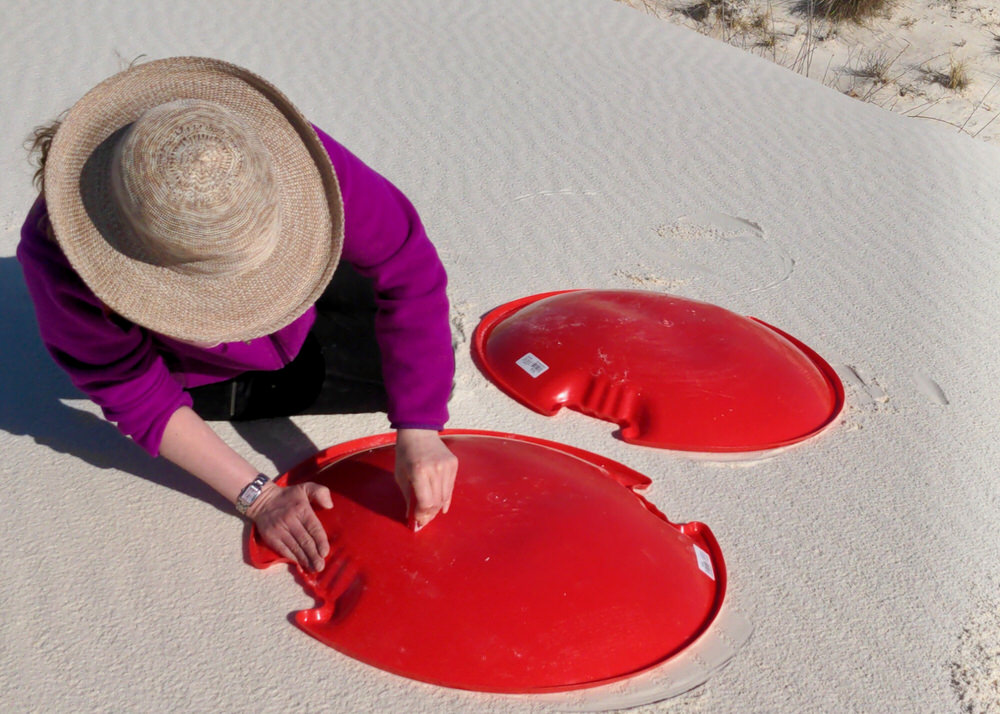 In addition to buying a saucer in the visitor center, you’ll also want to pick up some wax. To get the most speed on the dunes, the National Park Service recommends you wax the bottom of your sled. We found the wax we purchased in the gift shop (for $2.99 a lump) pretty tricky to apply.
For better results (and to save a buck), plan ahead and bring your own wax. If, like me, you keep paraffin in your house because it happens to be the secret ingredient in your aunt Ginna’s peanut butter ball recipe, just bring that. Or maybe try the remnants of an old candle. A crayon might even do the trick.
For sure, if you’re a cross-country skier, you can definitely rig up something better with actual ski waxes. We wondered if you could just bring a bottle of cooking spray along and just spray down the sled bottoms. Maybe the cooking spray would have an adverse effect on the dunes? If so, let me know!
3) Hit the slopes
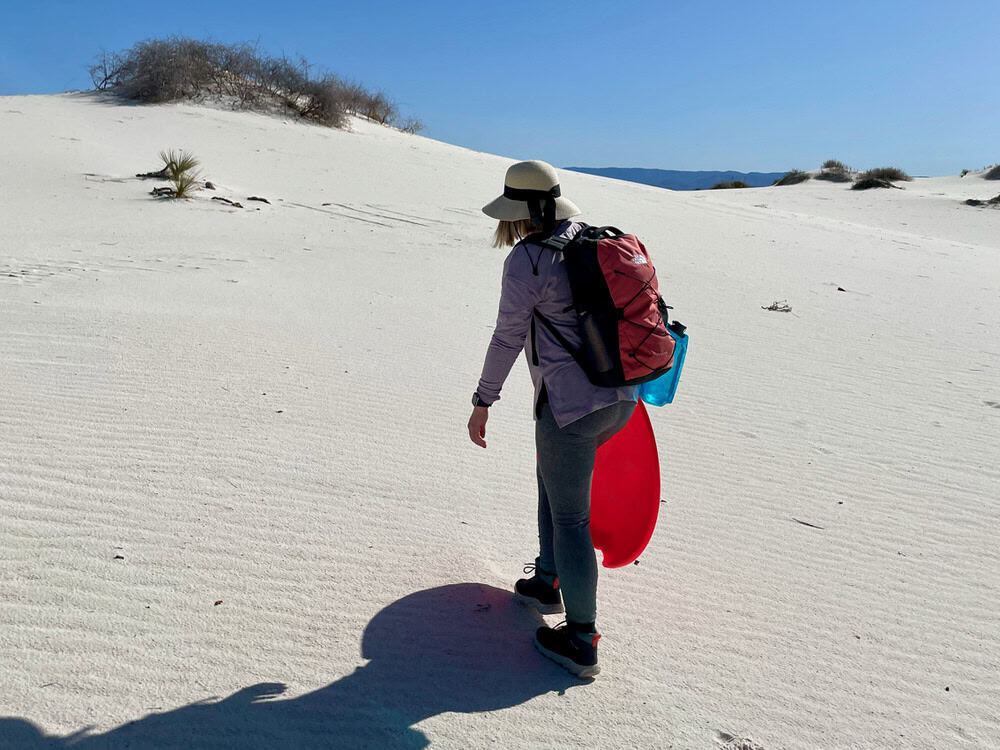 The last thing you need to do is find a good sand dune and go zooming down! And yes, it’s just as fun as it sounds.
If you grew up in a winter climate, it’s pretty intuitive what to do. Hop on the sled, scoot along until you get some glide, and then lean back.
A lot of the park’s instructions tell you go down the slopes with your legs straight out. I’m not sure what the purpose of this is, other than for braking. It does get pretty zippy towards the bottom of the dunes. We definitely picked up the most speed when we tucked our legs up on the saucer, but this did lead to some epic wipeouts.
Tips for sledding at White Sands
 Sled down east facing slopes only. They’re protected from the prevailing westerly wind and more stable than the dunes’ western sides.
Avoid vegetation at the bottom. Although it may appear to be an endless expanse of sand, plenty of things grow and live in White Sands National Park. You’ll find a fair amount of vegetation in the flat stretches of compacted sand in between dunes. Today, more than six months after my sledding adventures, I still have a (albeit small) scar on my upper arm from getting really friendly with a rosemary bush at the end of a sledding run.
Brace for a sudden stop at the bottom. Gypsum sand is quite soft, especially in the dunes, but the ground in between the dunes is very firm. Instead of gliding out a ways like you would on snow, expect to come to an abrupt halt as soon as you hit flat ground.
The more times you go down the same path, the speedier it gets. Just like with snow, the more you compact the sand, the more glide you’ll get.
Don’t forget to reapply wax. To keep your saucers zipping over the sands, you’ll need to reapply wax after every few runs. We probably stopped to apply wax three times during our visit.
Although this should go without saying, don’t sled towards the road!
Where to find the best sledding at White Sands National Park
 Even if you’re really eager to get sledding like we were, slow your roll. We did the majority of our sledding in the area just north of the Interdune Boardwalk on about 15 – 20′ tall dunes. We should have gone a little further before even thinking about waxing up those saucers.
You’ll find White Sands’ best, easily accessible sledding at the northern point of the Dunes Drive near the trailhead for the Alkali Flat Trail. The dunes are much larger – probably 30 – 40 ft tall – here and there’s little to no vegetation at the bottom.
What To Do at White Sands National Park (other than sledding)
 Above all else, White Sands is a sight to be seen. I expected to like this national park, but I really loved it. The gypsum sand is so unique both in appearance and texture. It’s hard to describe White Sands’ beautiful, vast, shimmering vistas. It’s truly something you need to see with your own eyes.
If you’re not interested in sledding, here are some other things to do in the national park:
Hiking
You’ll find several hikes under a mile at White Sands, including the Interdune Boardwalk and Dune Life Nature Trail. In addition to these short trails, you can do a five-mile loop on the Alkali Flat Trail.
Camping
If you’re interested in backcountry camping, the national park does have a backcountry camping area accessible via a 2.2 mile loop trail.
Check out the visitor center
The visitor center is an attraction in and of itself. Built in the 1930s as part of a job creation project, this adobe revival building is part of a national historic district. Interestingly, you can visit the visitor center without paying the entrance fee. The pay station is a little further up the Dunes Drive road.
Have a beach day
I was suspicious about just how beachy a location in landlocked New Mexico would feel, but it really did seem as though an ocean might be right over the next sand dune. With its notoriously good weather, you can have a beach day (minus water) at White Sands. We saw a couple groups camped out under beach umbrellas in a bold “living their best life” move. I have to admit, lounging on the cool sand reading a book sounded pretty tempting. Just don’t forget the sunscreen!
Take photos
White Sands is a destination darling among Instagrammers. You can get pretty epic influencer style shots here without even trying. We definitely saw at least one lady in a flowy dress trekking out into the sands with a professional photographer trailing her. Photographers particularly flock to White Sands at sunrise and sunset and for astrological phenomenons.
 |
 |