This post may contain affiliate links. When you purchase something through these links, I receive a small commission that helps me create this blog’s content. There’s no extra cost to you. Read my privacy policy to learn more.
Published: 2/21/2025
A Guide To What To Eat in Normandy, France
If you’re heading to Normandy soon, you’ll want to make sure you’re trying all the best food that this region of northern France is known for.
In this post, I’m sharing all about Normandy cuisine, including what it is, what makes its special, and which foods to seek out worth seeking out. With abundant orchards and coastline, Normandy food trends towards apples and seafood. You’ll also find plentiful creperies, hearty sausages, special pastries, and the most expensive omelet in the world.
During my time in Normandy in November 2024, I made a point to try as many regional delicacies as possible. I can assure you that there’s a reason that Rouen, the capital of the Normandy region, is an UNESCO City of Gastronomy. Whether you like caramel, cheese, or a tasty tipple, you’re sure to find a new delicious food favorite in Normandy.
Read on to learn what foods you should go out of your way to sample while you’re in northern France.
The 4 “C”s of Normandy Cuisine
If you’ve done any research into what to eat in Normandy, you’ve probably run into references to the “4 ‘C’s of Normandy Cuisine.”
The four ingredients considers emblematic of Normandy are:
- Calvados
- Camembert
- Cream
- Cider
In many ways, these four ingredients tell the story of northern French cuisine.
As the only region in France that doesn’t produce grapes, Normandy turns to its orchards when crafting alcoholic beverages.
Since Normandy’s rolling hills are dotted with crops and livestock, it’s no surprise that animal products feature heavily in Norman dishes. It’s a rare Norman dish that doesn’t involve a splash of cream in its sauce.
Food production is a major industry in Normandy and the region produces more than 30 cheeses, the most prized of which is the mild, soft Camembert.
While you won’t struggle to enjoy these four Normandy specialties, there are so many other great Norman foods to seek out during your visit. The region’s long coastline gives it excellent access to seafood and you don’t want to visit without sampling their savory buckwheat crepes known as galettes.
13 Famous Normandy Foods
1) Shellfish
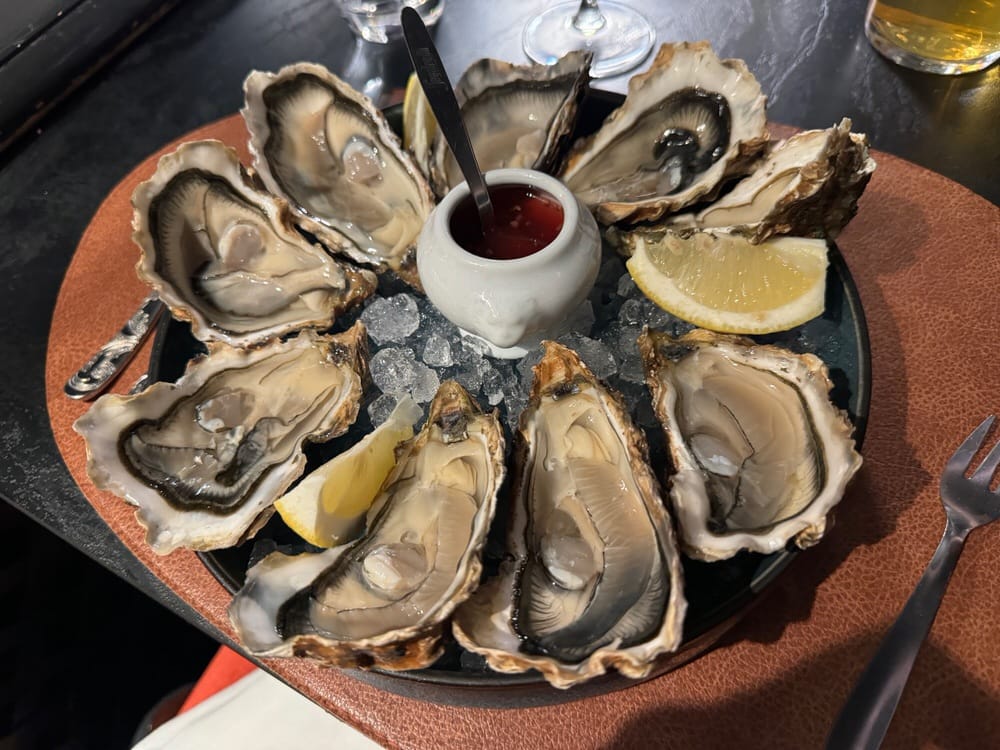
With almost 400 miles of shoreline, the first food you should go out of your way to enjoy in Normandy is seafood. Shellfish freshly caught from the chilly English Channel feature prominently on many menus in upper Normandy, particularly in seaside towns like Etretat, Honfleur, and Dieppe.
Even if you’re not sure you like shellfish, this is the perfect place to sample some of the freshest scallops, oysters, mussels, and lobster you’ll ever have.
2) Marmite Dieppoise
Another popular way to enjoy Normandy’s wealth of seafood is in a seafood stew known as Marmite Dieppoise. As the name implies, the dish originated in the small seaside town of Dieppe in northern Normandy.
While similar to a Bouillabaisse, the Normans differentiate their seafood stew by seasoning it with cayenne and/or curry powder and of course, using some of their most acclaimed regional ingredients including butter, cream, and even cider. A variety of fish are used and the dish is finished off just before serving with some steamed mussels.
3) Cider and Poire
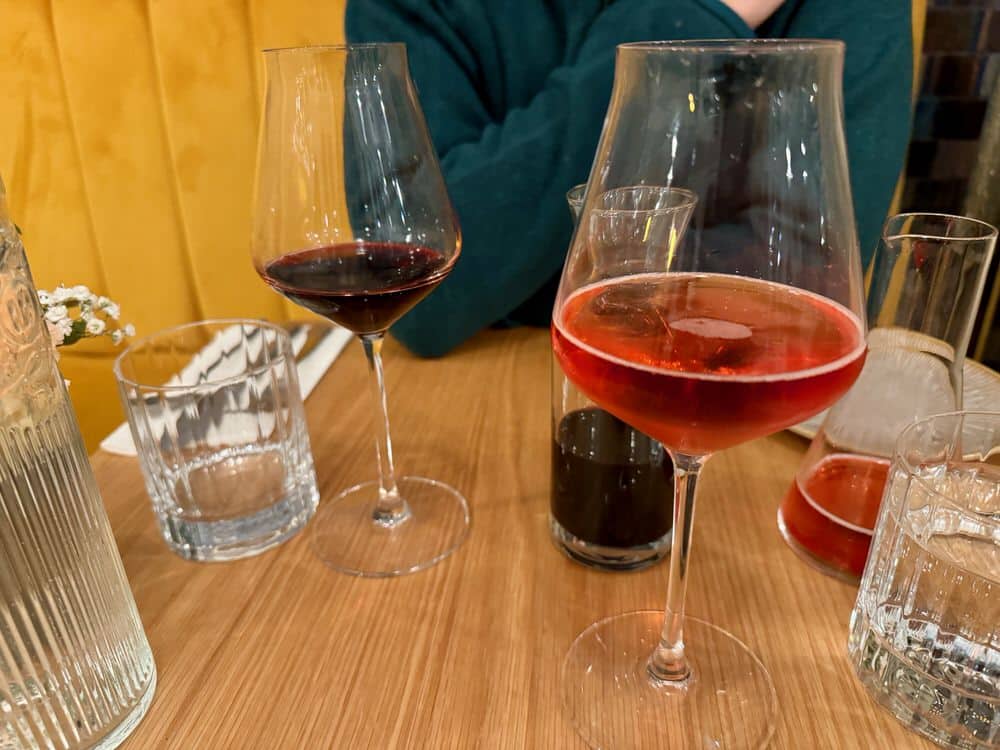 Normandy is the only region of France that doesn’t produce wine. Instead, plan to sample a wide variety of locally made cider, including this delicious rose cider pictured on the right.
If you head to Normandy hoping to sample local wines, you’re going to be sorely disappointed. This is the only region in France that doesn’t produced wine. But what pastoral Normandy lacks in vineyards, it makes up for with orchards. Many of those apples are turned into the mildly alcohol beverage of choice in Normandy: cider.
We quickly discover that Norman ciders possess a wide range of flavors. They can be sweet, dry, or even a little musty. Since cider is extremely inexpensive (we’re talking 3-4 euros a bottle), you can just pick up a selection at the local market and sample away until you find your favorite.
If you don’t find an apple cider to your liking, you might try poire instead. This is a hard cider made with pears, which are also grown in Normandy.
With an alcohol content of about 2-3%, you don’t have to worry about overdoing it with cider or poire. In fact, the alcohol content is so low that it’s not uncommon for it to be served to French children.

4) Calvados
The Normandy orchards also produce harder stuff. Calvados is an apple brandy that according to French appellation laws must be produced in Normandy to earn the name “calvados.” Often referred to in shorthand as AOC (appellation d’origine contrôlée), the French appellation laws control how and where specific French products like wine and cheese can be made.
Calvados is made by distilling cider into a clear by-product known as a eau de vie. The eau de vie is then aged in oak casks for at least two years where it develops a velvety, brown color similar to whiskey. Since calvados only gets smoother the longer it ages, expect to pay a pretty penny for best quality calvados. Alcohol content ranges from 40-50%.
Just like with the area’s cider, pears are also sometimes incorporated into this liquor. Calvados Domfrontais must use at least 30% pears in its production according to French appellation.
You can sip calvados on its own, or mix it with a little water or tonic. It’s also a fairly common ingredient in cocktails at bars around the region. (If you plan to take some bottles home as a souvenir, remember to pack some Wine Skins!)
5) Pommeau
Can’t decide between cider or calvados? Enjoy the best of both worlds by ordering a pommeau. This aperitif is made by blending unfermented apple juice and apple brandy. It is also often enjoyed with dessert.
You might see this drink listed on menus as pommeau de Normandie. That just means calvados was used for the apple brandy. A pommeau de Bretagne uses lambig, the Breton apple brandy.
6) Andouille de Vire
Farming is at the heart of both Normandy and Picardy life. Normandy in particular is known for its orchards and dairy, so it’s no surprise that dinner fare around northern France trends towards hearty, “stick to the ribs” dishes. Favorite Norman main dishes like roast chicken, lamb, and braised beef cheek might trick you into thinking you’re in the Yorkshire Dales or Irish countryside.
Just like folks from the British Isles, the Normans love their charcuterie. One favorite sausage to try in Normandy is Andouille de Vire. Made from pork chitterlings (yep, that’s a fancy way of saying “large intestine”) this aged, smoked sausage originated in a small village in lower Normandy. Enjoy it warm or cold.
 7) Galettes
 7) Galettes
If you can only eat one food during your Normandy travels, make it a galette. I’ve always thought of a galette as a rustic pie where you spread your filling in the center of a round of pastry and then fold the edges over to hold in and partially cover the filling. I’ve even baked one of these galettes at King Arthur Baking School during this fall trip to New England.
But if you order a galette in Normandy or Brittany, you’re definitely not getting a pastry. Instead, a Norman galette is a thin buckwheat crepe with savory fillings. (Yes, they’re naturally gluten free.) While you can put fill your galette with whatever suits your fancy, the most common fillings are ham, cheese, and egg. This is called a “galette complète.”
Tip: Galettes make a fast, filling meal any time of the day, but if you’re an American struggling with France’s late dinner hour, you can almost always track down a creperie in Normandy that’s open in the late afternoon and early afternoon.
8) Souffle Omelette de la Mere Poulard
Everything’s overpriced on Mont St. Michel, the tidal island that’s home to Europe‘s most picturesque abbey. While I generally recommend skirting most of the tourist trap restaurants that crowd the base of the abbey, if you’ve been saving your pennies, there is one special Norman food to seek out here: Souffle Omelette de la Mere Poulard.
As the name implies, this is basically a cross between souffle and omelet. An amazingly light omelet is created by whipping eggs into an absolute froth and then cooking them very quickly in butter over an open fire in La Mere Poulard restaurant. The omelette is taken off the heat before it’s completely cooked through and then folded over itself to create a foamy, melt in your mouth omelet.
Since this omelet has the somewhat dubious distinction of being the most expensive omelet in the world, I opted for a Nutella crepe instead during my visit. Not only did this save me considerable euros, it’s also still a regional specialty!
9) Soft cheese
Four cheeses produced in Normandy have earned AOC designation: Camembert, Livarot, Neufchatel, and Pont l’Eveque. All soft cheeses with rinds, these are among the longest produced cheese in France. Neufchatel cheese is thought to have been made as far back as the 6th century!
Camembert: Similar in taste and use to Brie, this cheese is the mildest of the four Normandy cheeses. Maybe that’s why it’s the best known to Americans. It is certainly the easiest Norman cheese to source once you return to the United States.
Livarot: Of the four Normandy cheeses, I preferred Livarot cheese. While still soft, this cheese is firmer than the other Norman cheese. It has a distinctive orangey color and a pleasant nutty flavor.
Neufchatel: This cheese is easy to spot in French markets because it’s almost always molded in a heart shape.(Appellation doesn’t stipulate what shape the Neufchatel is molded in, but most Norman cheesemakers seems to lean into the distinctive . . . and adorable, heart shape.
If you think this is going to taste like Philadelphia cream cheese’s Neufchatel, you’re in for a shock. Not only would this not spread particularly well on bagel, it also has a much grainer texture and a pungent flavor.
Pont l’Eveque: Yet another soft, creamy cow milk cheese that originated around Caen in a Cistercian monastery in the 12th century.
10) Crepes
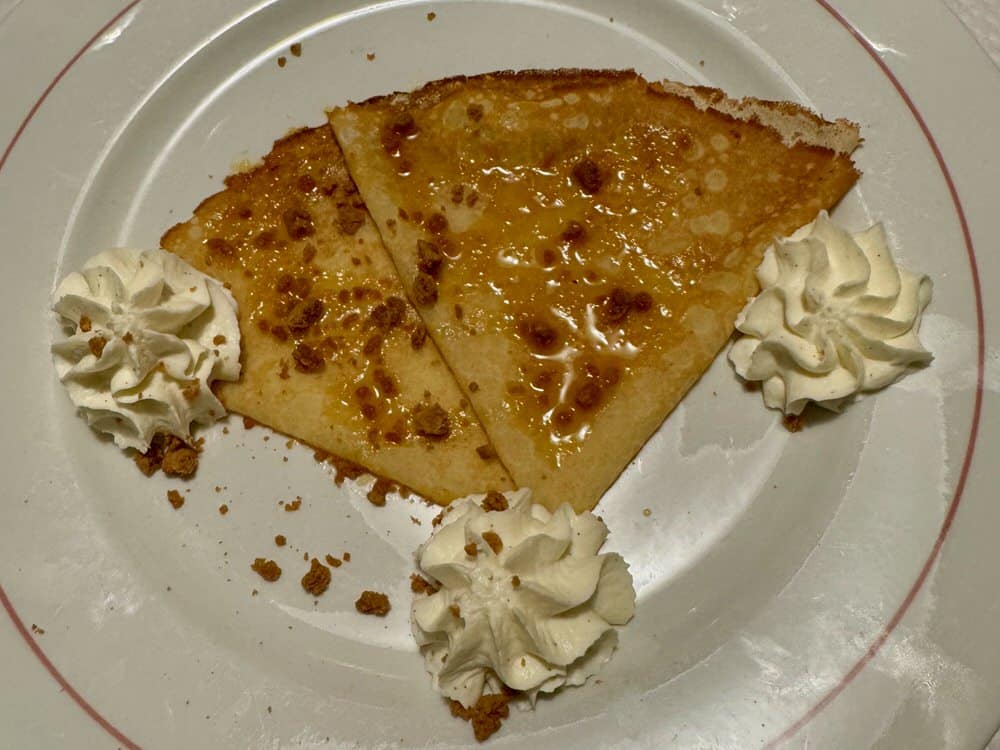
At a Norman creperie restaurant, you’ll see the menu divided into a section for galettes and another for crepes. While crepes technically originated in the neighboring French region of Brittany, they’re an extremely common treat in Normandy.
(Since Brittany and Normandy still argue over who technically claims Mt. St. Michel, I think you’re safe to enjoy crepes regardless of which side of the Couesnon River you’re on.)
In general, galettes have savory fillings, while crepes use sweet toppings. Another distinction between the two thin pancakes are that galettes use buckwheat while crepes are made with wheat flour. If you’re gluten free, you can always ask for your sweet “crepe” to be made using the galette batter.
I prefer my crepes topped with Nutella, but they are also nice with fruit jam, bananas, whipped cream, or even just a light sprinkling of powdered sugar.
11) Caramel D’Isigney
While Normandy doesn’t shy away from using one of its favorite ingredients – crème – in its sauces, perhaps the most delicious way to enjoy this regional specialty is in a luscious caramel candy.
Although we drove right past the Isigny Sainte Mere factory where these sticky sweets are made, we didn’t stop on our way to Utah Beach on the Cotentin Peninsula. Caramels have been produced in the small town of Isigny-sur-Mer since the 1930s. Today, the factory makes 70 different varieties and uses their famed caramels in syrups, sauces, and various other products like popcorn.
If you want to get your hands on these artisan caramels, your best bet is to swing into Les Halles D’Isigney next to the factory. During the high season (April – October) Les Halles serves up their much-acclaimed ice cream. With an extensive selection of regional grocery items, it’s also a great place to pick up an edible Normandy souvenir.
12) Tarte Normande
Normandy doesn’t reserve their impressive apple crop just for alcoholic beverages. A fair amount of those apples make their way into the bakery to be the starring ingredient in a Tarte Normande.
This simple apple tart is exactly what it sounds like. Slices of apple are arranged in an overlapping circle on top of a mild custard or layer of almond frangipane in a shallow short crust pastry. In other parts of the world, like the United States or United Kingdom, this tart is simply referred to as a French apple tart.
13) Le Saint Eve Patisserie

The Norman town of Bayeux has a specialty pastry known as Saint-Eve. It’s hard to track down the exact origins of this treat, but you’ll find it in many Bayeux patisseries including Patisserie Ordioni, Maison Lemoisson, and La Pâtisserie de Guillaume.
When you slice into the meringue topped dome of a Saint-Eve you discover an almond sponge base topped with liberal amounts of almond flavored buttercream and a dollop of chocolate mousse. The Saint Eve I purchased from La Patisserie de Guillaume was also rolled in chocolate shards. Naturally gluten free, it’s quite a dry and sweet pastry.
Honestly, I thought the chocolate slice with mousse and praline (pictured on the right above) was much nicer than the Saint-Eve, but I still think you should at least try Bayeux’s special pastry while you’re in town, even if it doesn’t turn into your go-to patisserie order.
What You Should Know About Normandy Food
 What You Should Know About Normandy Food
While it can be a little overwhelming to know where to start with Norman cuisine, you won’t struggle to enjoy the “4 ‘C’s of Normandy food” – cider, calvados, cream, and Camembert cheese – during your travels. These popular ingredients and flavors are incorporated into many Norman dishes.
One you’ve found your favorite “C”s, start to sample the local seafood and the other three popular Normandy cheeses: Livarot, Neufchatel, and Pont-l’Evêque. You’ll also want to plan at least one galette meal, although chances are you’ll find excuses to eat crepes and galettes nearly every day. Don’t forget to save room for a slice of tarte normande or a specialty pastry.
I hope this post has you excited about all the delicious food to try during your trip to Normandy. With such a wide range of dishes, sweets, drinks, and cheeses hailing from northern France, you’re in for a tasty visit.
 |
 |