This post may contain affiliate links. When you purchase something through these links, I receive a small commission that helps me create this blog’s content. There’s no extra cost to you. Read my privacy policy to learn more.
Published 2/24/2026
On the hunt for the best pastries in Copenhagen, Denmark
If you’re a fan of tracking down the best local food during your travels, you probably already know that Denmark is renowned for its excellent bakeries. You could base an entire (delicious) trip to Copenhagen around tracking down the best pastries from the Danish capital’s plentiful bakeries.
On my recent trip to Denmark and Sweden in December 2025, I didn’t devote my entire trip to eating pastries (there were too many other fun things to get up) but we did visit many of Copenhagen’s cozy cafes and bakeries. We even went on a delicious pastry tasting walking tour.
I want you to have the same tasty experience in Copenhagen that I did, so I’ve rounded up some of the iconic pastries found in Danish bakery cases. Whether you’re looking for a custard-filled flaky pastry, a more substantial roll to start your morning off, or a special holiday treat, you’re never far from a high-quality bakery treat in Denmark.
Just don’t order a “Danish” at the bakery counter. The pastry that Americans associate the most with Denmark doesn’t actually exist in Europe, but I’ll introduce you to the delicious pastry that North Americans adapted into the pastry we all know and love.
Let’s jump right in get you all sorted on what Danish bakery culture is all about. My mouth is already watering!
Important Danish Bakery Words to Know
We’ve all had the experience of confidently ordering something in a foreign language and realizing in the first bite that we had no idea what we were getting. Here are some common Danish words you’ll see in bakery cases to make sure each trip to the bakery in Copenhagen is delicious.
- Æble = Apple
- Baer = Berry
- Bolle/r = Bun/s
- Brikes = Poppy seeds
- Brød = Bread
- Hintbaer = Raspberry
- Lag = Layer
- Kage = Cake
- Kanel = Cinnamon
- Kirsebaer = Cherry
- Kugle/r = Literally “bullet” this is used to describe ball-shaped sweet treats like cake balls
- Rhubarb = Rabarber
- Rundstykker = Roll (literally “round pieces”)
- Rug = Rye
- Småkager = Cookies
- Snegle/Snurrer = Literally “snail” or “spinning” this is used to describe a swirled bun like a cinnamon roll
- Snitter = Refers to tray bakes or dessert bars that are sliced into serving portions
- Surdjes = Sourdough
- Te = Tea
- Valned = Walnut
9 Delicious Danish Pastries To Try in Copenhagen
1. Spandauer (“Danish”)
If you’re charmed by the idea of eating a Danish in Denmark, you want to order a spandauer. These individual pastries can be round, square or any shape in between. They always have a filled center. They’re made from a flaky, yeasted dough known as wienerbrød, which translates from Danish to “Vienna bread.”
That’s right, what you and I call a Danish, the Danes call “Vienna bread.” If the flaky pastry reminds you of a croissant that’s because the Napoleonic conquests brought French patisserie to Austria.
In the mid-19th century, Danish bakers went on strike. Austrian bakers stepped in, bringing with their French inspired techniques north. This fusion of Danish, Austrian, and French baking traditions resulted was some of the world’s most iconic pastries.
While spandauer is the closest you’ll come to a North American Danish, it’s important to note that it’s not a facsimile of the pastry you already know and love. I found spandauer to be very flaky; much closer to a croissant than the softer pastry that I associate with North American versions of this treat.
For the closest approximation to the pastry you’re familiar with, order a spandauer med vanilje, which will be filled with a vanilla flavored pastry cream. (Sorry, no cheese fillings on this side of the Atlantic.) You’ll also see fruit fillings, chocolate fillings, and even some savory variations with cheese and veggies.
2. Tebrikes
These rectangular pastries are popular breakfast treats. Made with wienerbrød, tebrikes are filled with remonce, another common Danish bakery ingredient that’s made by mixing butter, sugar, and marzipan or almond paste to create a filling that’s similar to frangipane. The filling is sometimes also flavored with citrus zest. Before baking, the pastry receives a healthy coating of poppy seeds (birkes).
You might also spy frosnaper in bakery cases. These are basically the same pastry as tebrikes, featuring remonce and poppy seeds, but twisted into a breadstick shape.
3. Kanelsnegle
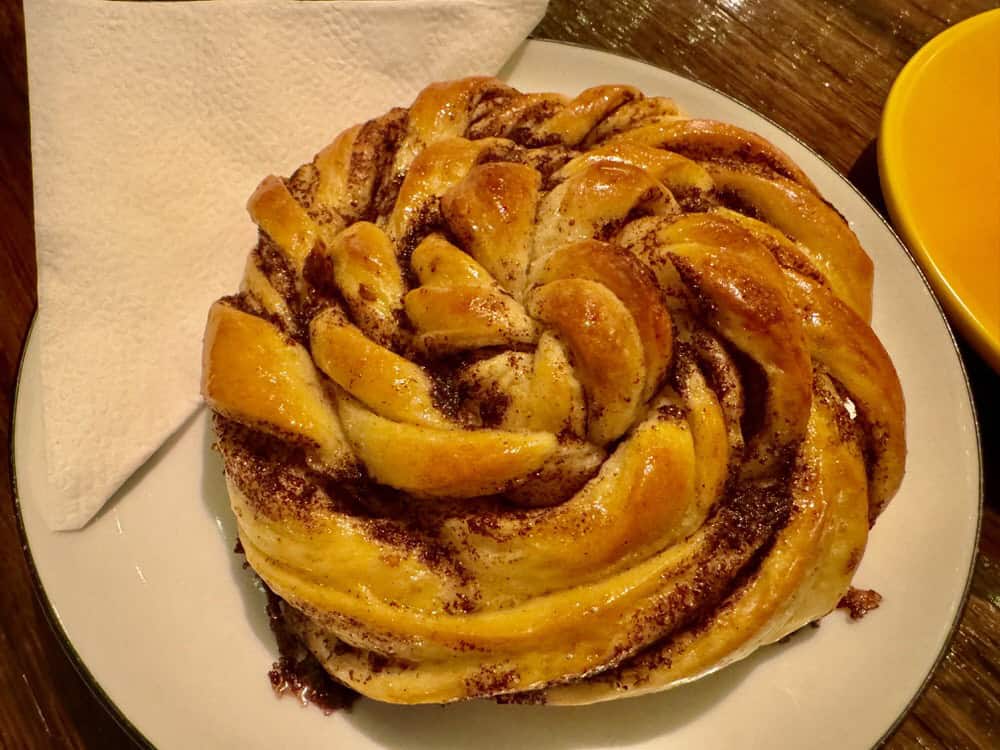
Cinnamon rolls are very common in Scandinavia, but you’re proably not going to get a gooey, doughy cream cheese frosted swirl. Instead of being sliced from a roll of dough and baked so the rolls run into each other, in Denmark and much of Scandinavia, cinnamon buns, orkanelsnelge (literally “cinnamon snail”) are shaped individually.
Each kanelsnelge is made using strands of cinnamon sugar filled enriched yeasted dough that are twisted around each other to create an attractive circular pastry. You can thank the neighboring Swedes for this shaping technique. The buns are then topped with either pearl sugar or sugar syrup rather than frosting. They’re still soft and sweet, but perhaps a little drier and less sweet than you might be expecting from an American cinnamon roll.
Have your heart set on a soft, pillowy cinnamon roll? Be on the look out for onsdagssnegle. Onsdagssnegle translates to “Wednesday roll” and yes, they’re sold on Wednesdays.
It’s said that Sankt Peders Bageri, started the onsdagssnegle tradition in the 1980s, when they baked large frosted kanelsnegle on Wednesdays to drive business on an otherwise slow day. In the 1990s when the Danish football team was doing very well, it became customary to pick up some onsdagssnegle to eat while watching the Wednesday football match. Talk about my kind of game day snacks!
4. Kardemommesnurre
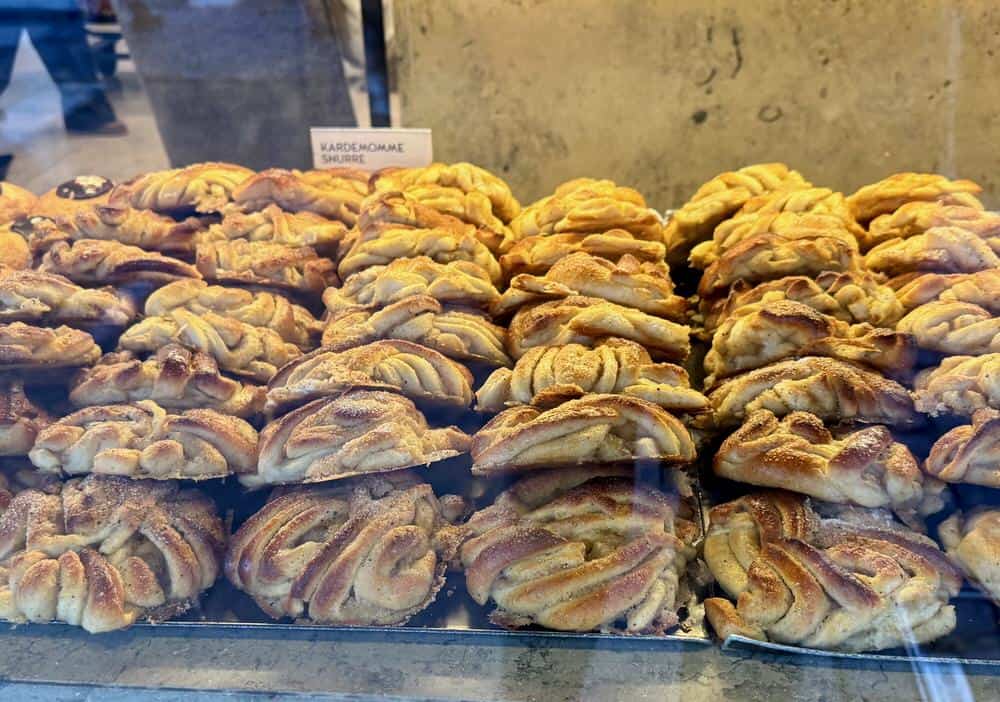
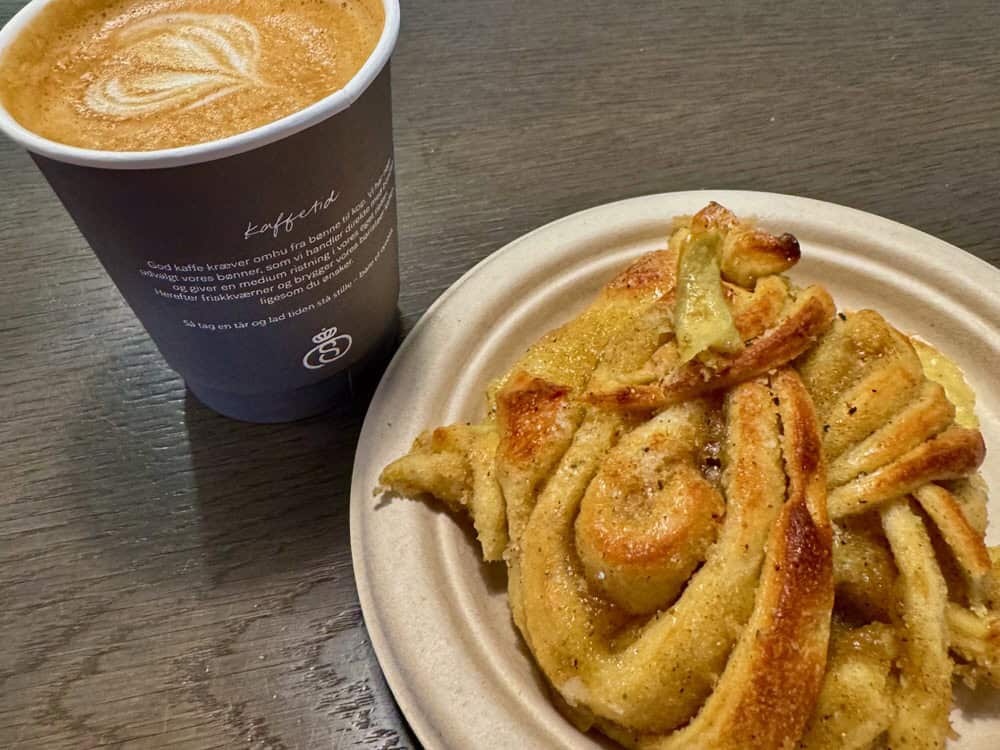
Kardemommesnurre (cardamom swirls) are prepared in the same way at kanelsnelge, but flavored with cardamom rather than cinnamon. It might just have been the particular bun I sampled, but I found these drier than the kanelsnegle. They are both intensely sweet and cardamom flavored. The cardamom sugar melts and caramelizes in the baking process and then hardens into crunchy bits on the bottom of the rolls.
Cardamom is a pretty polarizing flavor so if you’re not sure how you feel about it, I’d recommend ordering a “back up” treat to ensure a successful Danish coffee break. While cardamom is a very popular in Scandinavian cuisine, it’s often blended with other spices which tone it down a bit, but it really gets the full spotlight in a kardemommesnurre.
5. Hintbaersnitter
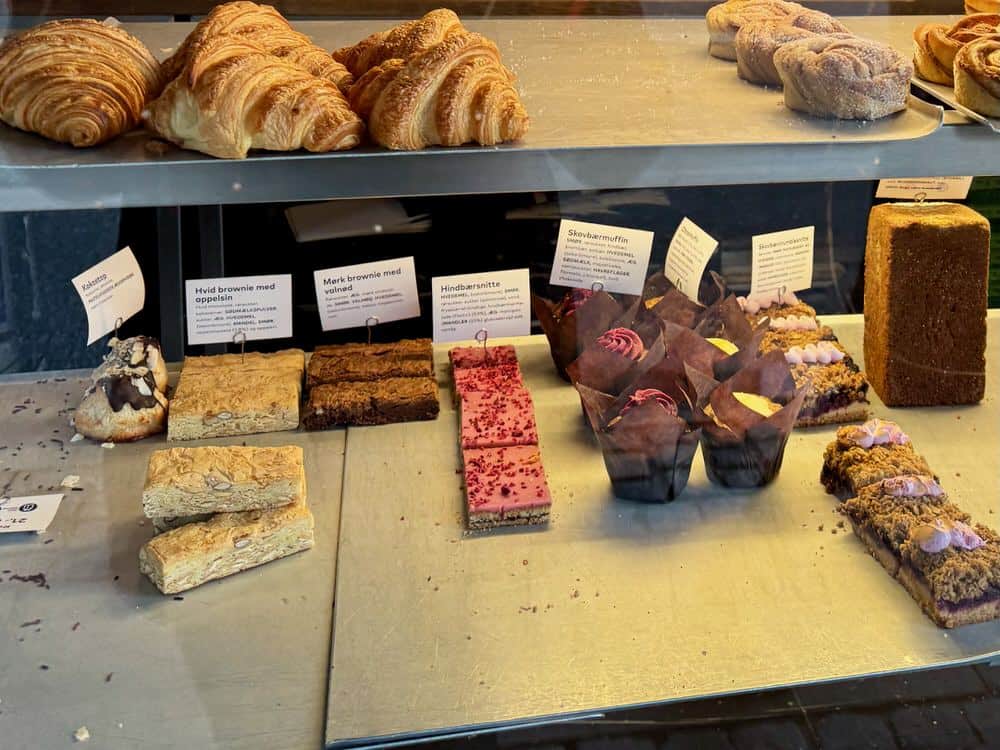
Kind of like a Pop tart, but even sweeter and decidedly more elegant, hintbaersnitter is a raspberry bar cookie. This tray bake is made with multiple layers of vanilla flavored shortcrust and raspberry jam. Once baked, the bars are topped with a thick coat of confectioner sugar icing and sprinkle of freeze-dried raspberries.
In Denmark these are particularly popular with kids and they’re often the featured treat at birthday parties, usually shaped as a kagemand or kagekone (Cake Man or Woman). The birthday child’s name is written on the kagemand and when the treat is served, the cake is “beheaded” while all the party guests are expected to scream in horror.
It’s said that hintbaersnitter was the favorite treat of fairy tale author Hans Christian Andersen’s favorite treat which further connects it with childhood.
6. Romkugler

Waste not, want not! Danish bakers weren’t about to throw out their day-old cakes so they created romkugler: the OG cake pops!
To make them, bakers crumbled up all their old cakes and wienerbrød then stirred in some cocoa powder, jam, and a little rum (hence the name which literally translates into “rum bullets”) to create a sticky mixture they shaped into balls. These truffle-like treats are then rolled in sprinkles, flaked coconut, more cocoa powder, or nuts and sold at a low price point.
Because they’re both cheap and very sweet, they’re especially beloved by Danish kids.
Full disclosure: I really disliked these. Some might describe the texture as “fudgy” but I found these claggy as all get out and the fact that they’d were completely coated in sprinkles only added to my textural misery.
At Christmas time, you might also see Dadelkugler offered. These sweet balls are made with dates rather than cake.
7. Morning buns (Rundstykker and Surdejsboole)

These simple buns are staples of Danish breakfasts. Rundstykker just means a round yeast roll, while a surdejsboole is a rectangular sourdough bun. While they’re not exactly the most exciting bakery product you’re going to find in Denmark, they highlight the importance of fresh, high quality baked goods in the Danish culture.
They’re often served with butter, jam, or sliced of vesterhavsost, a delicious Danish cheese that tastes like a cross between Gouda and Parmesan. If you order a morning plate at a Copenhagen café, you’ll likely get one of these, paired perhaps with Skyr yogurt or a soft-boiled egg.
You might also see Teboller (tea buns) which are lightly sweetened breakfast buns made with enriched yeast dough. Sometimes seasoned with spices and raisins, they might remind you of English hot cross buns.
8. Brunviger
Brunviger is a beloved Danish coffee cake that’s almost like sweet focaccia. Made with a yeasted enriched dough that sometimes seasoned with cardamom and or cinnamon, the dough is pressed out and covered with a simple brown sugar caramel then baked to create a soft, sweet bready cake with a crispy, chewy brown sugar crust.
Recently this homey treat has had a bit of a glow up that started at Hart Bageri.
Instead of using a simple enriched dough, Hart took leftover bits of croissant dough (as we know, Danes are passionate about reducing food waste) tossed them with cardamom sugar and then baked them in tins to create an individual sized brunviger inspired treat. You’ll see this technique replicated at many other Copenhagen bakeries.
9. Seasonal pastries
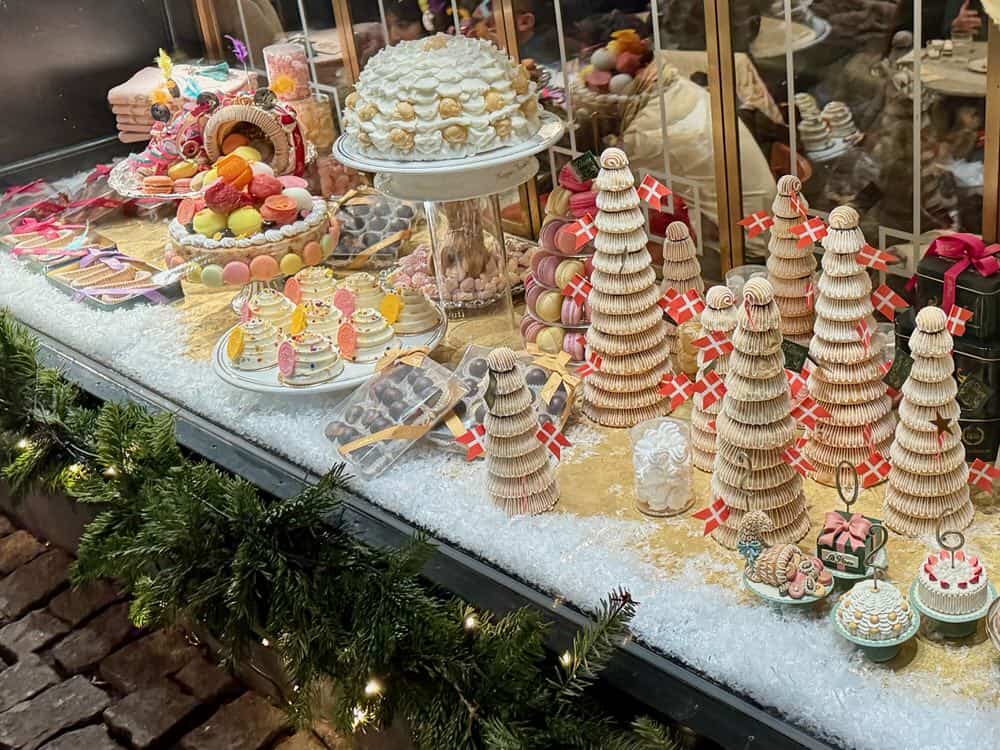
If you’re visiting near a holiday, it’s worth looking for some extra special Danish pastries in the bakery cases. Since we visited Copenhagen during early December several Christmas treats were available, including hominnghjerter a spiced fermented honey cake similar to German lebkuchen that’s shaped like a heart and dipped in chocolate.
Another popular Christmas bakery offering are jule morning buns. These soft yeasted buns are flavored with cardamom, cinnamon, orange, and dark chocolate or raisins. Or you might spy kransekage, a delicious chewy almond cookie common at both Danish and Norwegian celebrations like weddings.
If you’re lucky enough to be visiting in the days leading up to Lent, you’ll want to track down as many fastelavnsboller as you can. These soft sweet cream filled buns come in all sorts of flavor combinations, although cardamom and almond are most traditional. These are meant as a Shrove Tuesday treat to indulge in before Lenten fasting.
On Great Prayer Day, the fourth Friday after Easter in Denmark, it’s common to eat Hveder, a spiced wheat bun.
Favorite Copenhagen Bakeries

Now that you know what to order, here’s where to go in Copenhagen to seek out the very best baked goods. To be honest though, Danes taking their baking (and life) very seriously so you’re unlikely to find a bad pastry.
Albatross & Veneer
Located in Torvehallerne, Copenhagen’s famous food hall, this organic bakery is celebrated for its wienerbrød, especially its inventive savory pastries.
Andersen & Maillard
A beloved bakery and coffee shop in Norrebro, Andersen & Maillard cranks out classic Danish pastries off with a slight (and literal!) twist. They’re also a coffee roastery and some beans make a great Copenhagen souvenir.
BUKA
Consistently makes Copenhagen top bakery lists, BUKA has five locations around the city. They’re known for their beautiful stuffed croissants and sourdough breads. I also wouldn’t say no to a raspberry mascarpone spandauer.
Emmerys
A small chain bakery, Emmerys has locations scattered around the Danish capital. They’re known for their organic baked goods. If you have a birthday in your group while you’re visiting, you can pick up a hintbaersnitter kagemand or kagekone (raspberry square cake man or woman) to celebrate here!
Hart
If Hart Bakery is on your radar, it might be thanks to its appearance in The Bear tv series.
The bakery is especially known for its sourdough (Hart’s founder was once the head baker at San Francisco’s Tartine), but don’t miss their cardamom croissants. While these odd little rolls made with squares of croissant dough tossed in cardamom sugar might look, dare I say it, burnt, they’re caramelized perfection. There are 10 Hart locations in Copenhagen.
Lagkagehuset
This chain bakery has locations all over Copenhagen, including at the airport. It’s the perfect place to pick up your first Danish coffee and pastry before heading into the city.
Sankt Peders Bageri
As if being oldest bakery in Copenhagen was enough, Sankt Peders Bageri ensured its “beloved” status by giving us the onsdagssnegle tradition.
Copenhagen Danish Pastry Tour
If you’re pressed on time, one of the best ways to include a lot of bakeries and pastries in your visit is to go on the Copenhagen Danish Pastry Tour. I highly recommend it! Come with an empty stomach!
Conclusion: Danish pastries don’t disappoint
The pastries I’ve listed above are the ones I think are most unique to Denmark. However, they’re far from the only pastries and baked treats that Danish bakers churn out daily. You can also expect many beloved bakery favorites including croissants, pain au chocolat, and even banana bread. Denmark is also known for its excellent sourdough bread – especially rye and seeded loaves.
I hope this post saves you from decision paralysis when you finally make your way to a Danish bakery counter. But if indecision does settle in as you gaze upon the rows of spandauer, tebrikes, hintbaersnitter, boller, remember, when in doubt, don’t hesitate to order one of everything; you won’t be sorry!
 |
 |