
This post may contain affiliate links. When you purchase something through these links, I receive a small commission that helps me create this blog’s content. There’s no extra cost to you. Read my privacy policy to learn more.
Published 2/13/2026
How To Get Around London As A Tourist
You’ve probably heard that London has excellent public transportation, but if you’re planning your first-ever trip to London, hearing that “it’s really easy to get around” doesn’t really help you figure out London travel.
Fear not, I’m here to help!
I’ve boiled my decades of experience using London public transportation both as a tourist and a young administrative assistant commuting to work every day into essential need-to-know information about how you can use London transport in the cheapest, most efficient manner.
In this “wham bam, thank you ma’am” guide, I spell out all your public transport options, from the Tube and buses to ferries and light rail. I share how to pay and plan a route, along with my very best firsthand tips that will having you crisscrossing London like a pro, even if you run into a transportation worker strike or line closure.
I wrote this guide for the London tourist spending their entire visit in central London seeing favorite sites like Tower Bridge, Westminster Abbey, Kensington Palace, and the British Museum. If you need help figuring out how to get from Heathrow Airport into central London, I do have an entire post devoted to that.
Let’s dive right into everything you need to know about London public transport to get you navigating London so confidently that folks will be asking you for directions!
London public transport options
London public transport is operated by Transportation for London, which is often abbreviated to TfL.
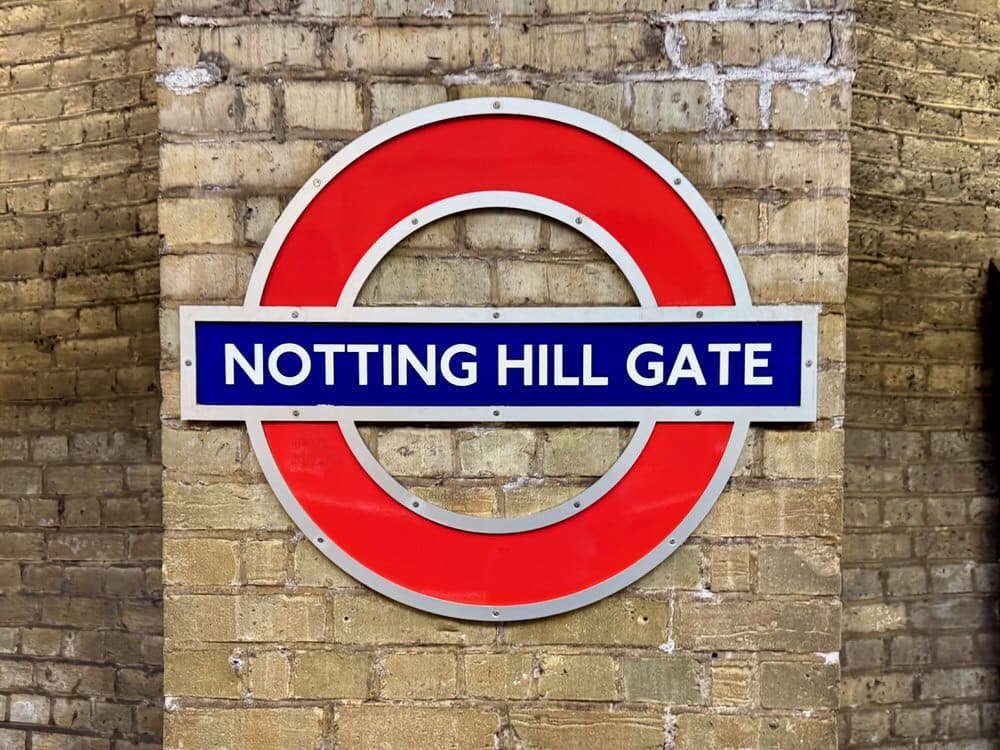
Tube/Underground
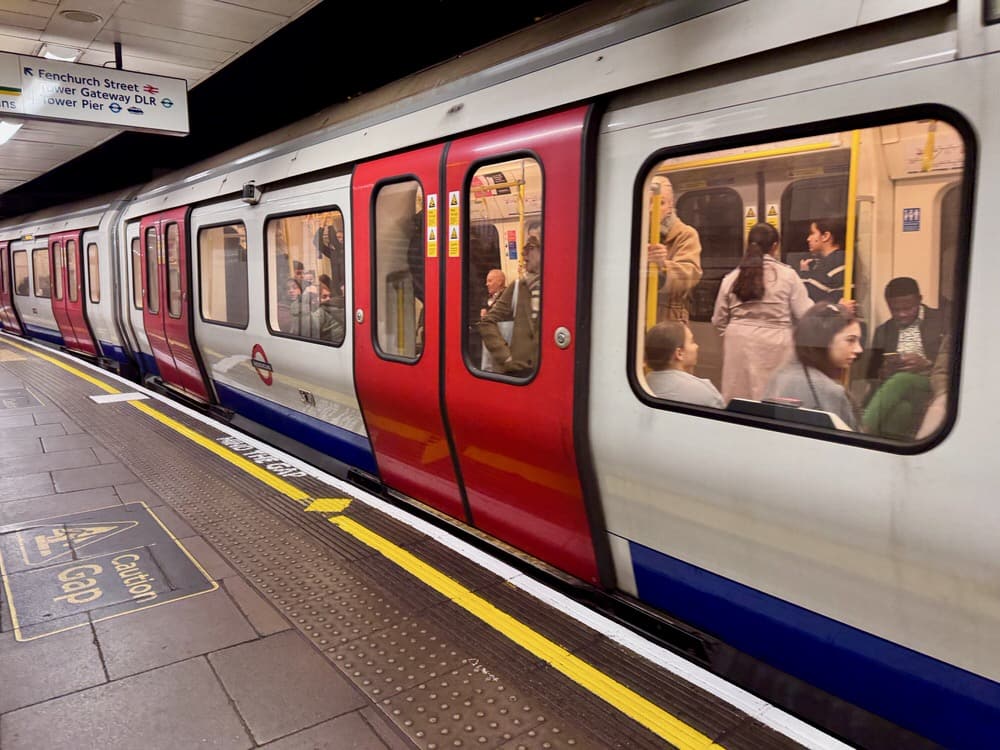
When people talk about public transportation in London, more often than not they’re referring to the Tube, London’s subway system.
Also commonly called the Underground, this mostly underground train system connects all corners of London. With hundreds of stops scattered around the metropolis, you’re never more than a 10-minute walk from the nearest Underground station.
If this is your first time in London, I strongly feel Tube is the easiest, most accessible transport system to figure out. Happily, it’s also the most efficient. With trains running about every 2-5 minutes on all the lines, you never have a long wait and you cover ground quickly. For example, to get from Notting Hill neighborhood to the Houses of Parliament (a distance of about 3.5 miles) takes about 15 minutes via the Tube.
The tube runs from approximately 5 a.m. – 12:30 a.m. each day. Five lines (Central, Jubilee, Northern, Piccadilly, and Victoria) operate 24 hours on Fridays and Saturdays.
Bus
London buses easily give you the most bang for your buck. (Err . . . quid?) Bus routes crisscross the entire city so it’s easy to connect to London places near and far. However, buses are slower than the Tube and you run the extra risk of getting stuck in traffic.
However, one underrated bonus of taking the bus is that you get a great tour of the city, especially if you opt for an upstairs seat. When I lived in Hammersmith, I actually preferred the bus over the Tube if I was headed towards Kensington Gardens or Trafalgar Square because it’s both more scenic and has more convenient stops than the Tube.
Bus schedules always feel intimidating to me, but with tools like Google Maps or Citymapper, it’s easy to figure which bus catch. I actually really regret not using any buses on our last trip to London. The Tube might be efficient, but it can be a little disorienting. Buses really help you get the lay of the city.
If you need to get around London very late at night, the most popular bus routes offer round the clock service.

Boat
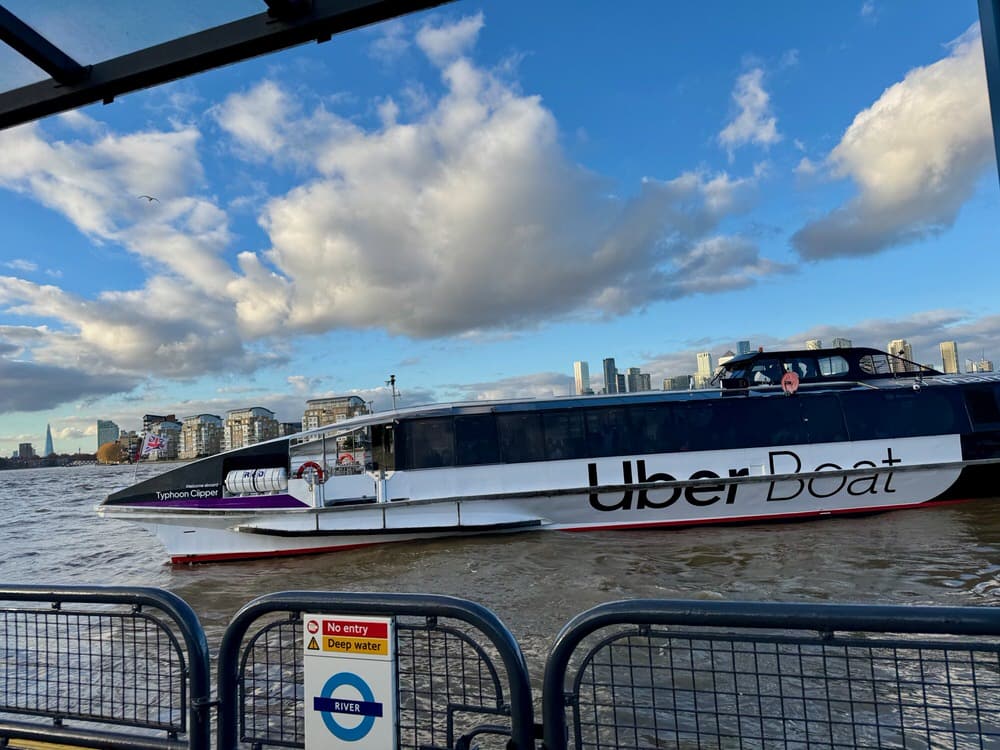
Uber Boats by Thames Clippers are set up with TfL’s pay systems, so you can hop on and off these passenger ferry boats using contactless pay. While other passenger boats, like sightseeing cruises, also operate on the Thames, Uber Boats is the only official “public” boat option.
The boats run up and down the river all day from Putney to Woolwich. For first-time visitors to London, you’re most likely to use this service if you take a day trip down to Greenwich . . . which I highly recommend!
Taking a boat on the Thames is peak London transport and I recommend that everyone do it at some point, even if it’s just a short cruise from the Tower of London up to the Houses of Parliament. It’s so fun to think you’re joining the leagues of folks who have been using the Thames to get around London for millennia.
Light Rail
A light rail network known as the Docklands Light Rail (DLR) provides East London with service coverage similar to the Tube in the rest of the city.
If it’s your first time in London, it’s unlikely you’ll use the DLR, unless you happen to be staying in East London, say, Canary Wharf or Greenwich. If you are based in this part of London, you can easily connect to the Tube system at Bank Station in the City of London.
Overground Trains
For farther afield London destinations like the Making of Harry Potter Tour or Wembley Stadium, TfL has a network of overground trains that go beyond the reach of the Tube system. The Elizabeth Line is a hybrid underground/overground train line that connects the outer reaches of London, including Heathrow Airport, with central London.
Trams
Trams connect a portion of southern London. It’s very unlikely you will ever use this service unless you happen to need to travel between Wimbledon and Croydon.
Cable Cars
I know it sounds crazy, but you can actually travel via cable car across the Thames in East London. This gondola lift service runs 90 metres above the Thames between North Greenwich and Royal Docks.
Bicycles
Santander Cycles is London’s public bike rental service. The service puts about 12,000 bicycles on London streets to be used mostly for short point A to point B rides. You’ll notice stands of them all over central London.
Non-TfL modes of public transport in London
Cabs
Black cabs are ubiquitous on London streets so if worse comes to worst, it should only take you a moment to hail an on-demand ride. However, you’ll pay for the convenience. Minimum fare is £4.20 and it can cost up to £13.00 to travel a mile.
London cabbies go through a rigorous licensing process and are extremely knowledgeable about the city. Just double check that you’re getting into a licensed cab. You can tell by a white license plate underneath the vehicle’s yellow license plate. There should also be driver registration information visible when you’re seated inside the cab.
Hop on/hop off buses
Both Big Bus and CitySightseeing operate Hop On Hop Off bus tours around central London.
While the commentary on these buses is usually pretty good, they tend to not run frequently enough to be a super efficient way to move between London attractions. Also, if you haven’t gotten stuck in a hop on/hop off bus at some point in your life can you even call yourself a traveler?
Rideshares
Uber and Bolt both operate in London.
E-bike and e-scooters
Lime and Forest have stands of e-bikes and e-scooters all over the city.
Everything You Need To Know About Using London Public Transportation
How much does it cost
To figure out exact fares for your planner trips, use the TfL’s farefinder.
- Single tube ride: £2.80
- Single bus ride: £1.75 (Free transfers for an hour after initial boarding)
- 24-hour max fare for Zones 1 and 2 travel: £8.90 (Bus only daily max is £5.75.)
If it’s your first time in London, it’s fairly unlikely that you will travel outside of Zone 1, let alone Zone 2. Learn more about how TfL handles fare capping.
You automatically are charged the best rate when you use contactless pay. No need to faff about with Travel cards, Oyster Cards, or the TfL app anymore. Hallelujah!
How to pay
When using any TfL service, look for the large yellow circular card reader to pay your fare, aka “tap in.”
You’ll find these yellow readers located on the ticket gates at Tube stations, next to the bus driver as you board buses, or on small stands on docks or train stations. Just hover your phone or card over the reader until you hear a beep and the ticket barrier gates open.
At the end of your journey, it’s very important that you “tap out” at one of these card reader stations as you exit the Tube station, dock, or train station. If you fail to tap out, TfL doesn’t know your travel route and defaults to charging you the maximum fare.
Note: Since buses are a set fee, you do not need to tap out.
How to pay if you’re traveling with kids
Kids under 10 travel free with a paying adult. For children ages 11 -15, your best option is to purchase a visitor Oyster card and then have a station staff member set it up with the 50% youth discount. Individuals 16 and older pay adult fares.
How to plan your route
My preferred route planning method is to pour over the London tube map. Of course, it’s faster to let an app do the heavy lifting for you. Just enter your starting point and destination into CityMapper or your phone’s maps app to figure out the most efficient route in seconds. You can also use the TfL Go app.
What to do before your visit
Before you head to London, set up contactless pay in your phone. That’s it. That’s all you have to do to start using London public transportation.
Ideally, set up contactless pay with a card that doesn’t charge foreign currency fees. (I use both a Delta cobranded Amex and a Chase Sapphire Preferred for this.)
While it’s true you can use any chip card to pass through the TfL ticket gates, I greatly prefer using my phone since it’s already in my pocket. If you’d rather not pay with your phone, you can skip this step. Just remember to always have a chip card handy and be sure you use the same card every time you tap in and out to avoid overpaying.
Rush hours
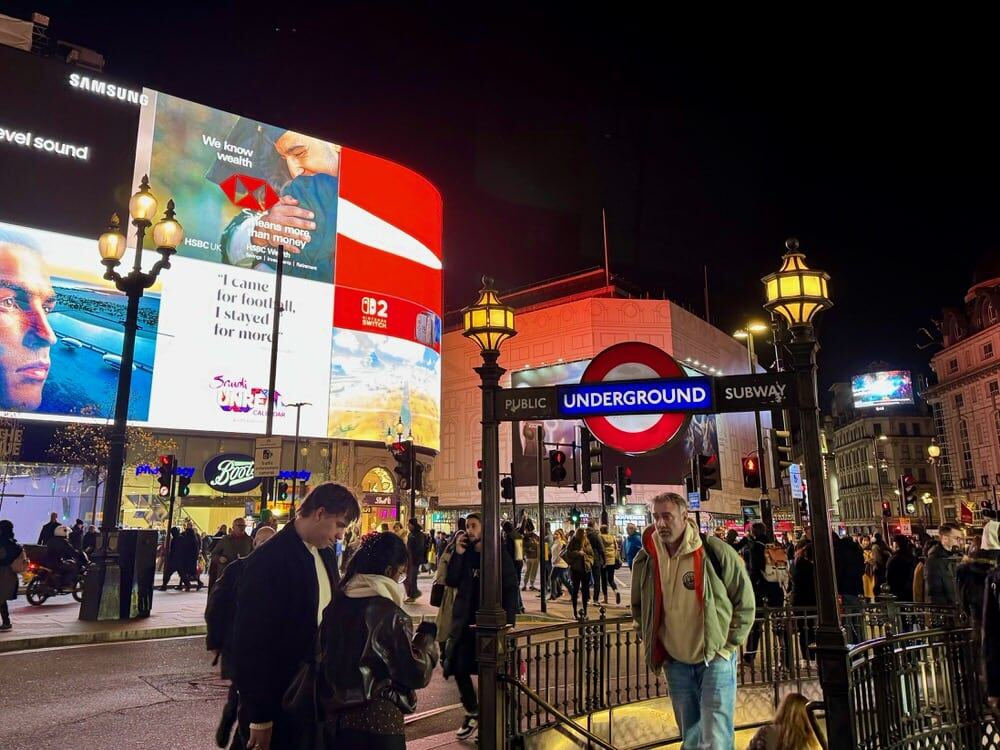
If you only use London transport in the middle of the day, you might be tricked into thinking that the service is wildly underutilized. But stumble into a Tube station over rush hour and the crowded platforms and trains tell the truth.
Rush hours are strictly limited to weekdays, but it’s not unusual for TfL to close lines for maintenance on Saturday or Sunday which can gum up weekend travel. Londoners definitely go to work a little later than their North American counterparts, so London rush hours may catch you slightly off guard.
Morning rush hour: Unless there are significant line closures (usually caused by an unexpected incident), the morning rush hour is usually pretty lowkey. Since most London attractions don’t open until 10 a.m. anyway, you probably won’t run into it. In my experience rush hour starts building around 7:30 a.m. and is heaviest from about 8:30 – 9:30 a.m. and concludes around 10 a.m.
Evening rush hour: This starts to really build around 4:30 p.m. with heaviest traffic from 5:30 – 6:30 p.m., concluding around 7 p.m. Trains can be crazy full during the evening rush hour, so I recommend planning an itinerary where you can walk between attractions and activities in the late afternoon/early evening.
Basic London transport etiquette
- Always prioritize seats for the elderly, disabled, and pregnant. To make it really easy to know who might need your seat, TfL offers little badges that folks who don’t have obvious disabilities or pregnancies can wear so you know when to yield your seat.
- If you’re traveling with luggage, consider standing for your journey so you don’t clog up the seating aisle.
- Always take your backpack off and keep it in between your feet or on your lap while riding the Tube. Nobody wants to get whacked with a backpack every time you move.
- When riding on the escalators at Tube stations, stand on the right. The left side is reserved for folks who want to walk or run up or down these steps.
- Let people disembark the train before getting on.
Best tips for using London transport
Know your various options and be ready to pivot
The beautiful thing about London transport is that there are always about half a dozen different ways to get from where you want to go. Take a minute to acquaint yourself with London’s transportation map so you know which other Underground lines or bus routes can get you to your destination if you need to throw plan A out the window.
While TfL does a really good job of announcing strikes and planned line closures in advance, accidents and unexpected closures happen all the time.
For example, when we returned from York, I planned to hop on the Piccadilly line to make a quick easy journey from King’s Cross Station to our South Kensington Hotel. However, a customer incident earlier in the day had closed down the line completely so we pivoted to a different line which necessitated a transfer. When surrounded by confused, upset travelers, it feels so good to quickly come up with and execute Plan B.
Don’t assume you need to use the Underground
The London Tube map can be a little deceptive when showing distance. Stops are sometimes much closer together in reality than they appear on the map.
In general, I only use the Tube when I need to travel farther than .9 miles. By the time you get through the station, down to the platform, and catch the next train, and get back to street level, you might have already been at your destination if you’d walked.
When in doubt, use your map app to determine if walking or riding will be faster.
Skip crowded trains
Underground trains roll through stations approximately every five minutes, so unless you really need to get somewhere fast, just wait for the next train if the first one you see is packed. It’s very likely that the next train to roll through will be much less crowded.
Be prepared for a strike
London public transport is dependable and easy to use . . . until the transport workers go on strike. About 3-4 weeks before your visit to London, it’s worth taking a look at the TfL website to see if any strikes or partial closures are planned for your visit so you can start to plan alternative transportation.
Most importantly, I’d recommend prebooking a taxi to and from the airport. This is also a great time to tweak your itinerary so that all the sites you plan to see in a day are within walking distance of each other so you only need to figure out transportation at the start and end of each day.
In all my time in London, I’ve never been around during a strike so it’s not something you need to loss sleep over. However, you don’t the first time you’re learning about a transport strike to be after you’ve landed in the U.K. There’s a reason TfL announces strikes in advance so do your due diligence.
Watch for fare dodgers
This isn’t super common, but if you notice that the person in front of you is struggling to get through the ticket gates, either go to another gate or wait until they’ve gotten through before hovering your phone or card over the reader. You don’t want to accidentally let the person in front of you through the gates and leave yourself up the proverbial creek.
Conclusion: Get ready to tap your way through London’s public transport system
Great, user-friendly public transportation is perhaps the number one thing that influences how I feel about a city. That’s probably why I love Milan so much and why I keep returning to London time after time.
As you can see, London offers a wide variety of public transportation options that are dependable, user friendly, and affordable. If it’s your first time in London, you’ll probably be astounded at just how easy it is to crisscross the city on the transportation method of your choice. I personally think the Tube underground train is your best first choice.
Once you crack the code to London’s public transportation, you’ll be able to see the best of London on demand. I hope this guide answered all your nagging questions about London transport options, etiquette, fares, and how to pay.
Now, get ready for fantastic travel in London and obviously, don’t forget to “mind the gap!”
 |
 |