
This post may contain affiliate links. When you purchase something through these links, I receive a small commission that helps me create this blog’s content. There’s no extra cost to you. Read my privacy policy to learn more.
Published: 3/3/2025
A Complete Guide to Driving in France
As a nervous driver, driving in France – let alone any foreign country besides Canada – has never been high on my travel bucket list. But as I started putting together our November 2024 itinerary for two weeks in northern France and Paris, it soon became apparent that trains and buses were only going to get us so far.
Yes, Europe does public transportation better than the rest of the world, but plenty of France remain accessible only by car. If we were going to go from Somme battlefields (literally in the middle of farm fields) to my great-uncle’s grave in a remote corner of Brittany, we were going to need to our own car in France.
Thankfully my friend Jenny’s steadfast driving on Portugal’s Azores Islands, inspired me to take the plunge into foreign car rental. With only a little bit of trepidation, I picked up a car in Rouen and started weeklong road trip through Picardy, Normandy, and Brittany. Happily, driving a car in France, especially the rural corners we explored, is very easy and extremely rewarding.
If you’re considering renting a car for your own French road trip, this guide covers all the basics of driving in France. We’ll talk about what documents you need to legally drive in France as an American, what to expect on French autoroutes, and even the headaches I ran into when gassing up our car. I’ve included lots of tips about navigating French roads and towns, paying tolls, and more.
Read on to learn everything you need to know to drive safely and successfully in France. The sites you can access around France when you have a car of your own are truly unparalleled and well worth bolstering your courage for.
So come on; let’s get you on the roads of France!

Documents You Need To Drive in France (As an American)
Valid American driver’s license – When I picked up our rental car in Rouen, the only piece of identification they were interested in seeing was my Minnesota driver’s license. Obviously you shouldn’t plan to drive in a foreign country if you don’t drive at least semi-regularly at home.
International Driver’s Permit – Technically you also need this somewhat dubious looking document to validate your driver’s license in France. The IDP as it’s often referred to, basically translates your driver’s license into the local language and can be used in 150 countries.
The only place to get an IDP in the United States is through AAA. You can either apply through the mail or in person. I just walked into my nearest AAA office and walked out with my IDP in less than 10 minutes. You’ll need to submit two passport photos with the application. The permit costs $20 and is valid for one year.
Even though I never technically “used” my IDP, apparently French police often ask for it if they pull you over. (They’ll also want a look at your driver’s license and passport.)
Insurance – Confession: I didn’t put much thought into car insurance before picking up our French rental car. I always decline whatever coverage the company offers me, assuming I’ll be good with my personal coverage and credit cards. Luckily I didn’t have any problems, but I would recommend doing a little more research into insurance coverage than I did!
One good tip, especially if you’re not fluent in French, is to have the U.S. embassy phone number in your contacts. That way if you have the unfortunate luck of getting into an accident, you can easily reach someone who can help you navigate the incident in English.
France Driving Basics
Right side of the road: If you’re an American or Canadian, driving in France is a breeze. Just like at home, they drive on the right side of the road in France. Whew!
Kilometers: As with all of Europe, France uses kilometers. Speed limits are in kilometers per hour and all distances on roadside signs are in kilometers.
Car size: You might expect cars to be much smaller in France than they are in the United States, but we didn’t find that to be true in rural France. Yes, there are some teeny smart cars, but most people drive sedans or SUVs. We spent a week driving around a Nissan Rouge and blended right in with . . . with the additional benefit of having plenty of space for our suitcase. You will notice a lack of pick-up trucks and their semis are definitely smaller.
Road features: When you merge onto a French autoroute, you might think you took a wrong turn and ended up on an American freeway. However, once you exit the autoroute, French roads can be quite narrow and winding. You’ll also soon realize that there’s a village approximately every two miles, which requires you to slow down to 30-50 kph as you pass through.
You also can’t talk about European roads without talking about roundabouts! France uses roundabouts for basically all of their intersections. Once you get the hang of them, they are very easy and efficient.
Manual vs. automatic: Most cars produced in Europe are still manual transmission. While it will make no difference to you what other folks are driving, you will want to book your rental car well in advance if you strongly prefer driving an automatic.
Weekdays vs. weekends and holidays: We picked up our rental car on Veteran’s Day and hit the open road . . . and were basically the only car on the road.
It also appears that most (all?) professional drivers like delivery trucks, semi-trucks, and others work a pretty standard Monday- Friday schedule with holidays off. If you’re looking for an easy introduction to driving in France, I highly recommend starting your driving adventure on a weekend or holiday.
Sharing the road with French drivers: There are a lot of negative stereotypes about French personalities, but I found French drivers to be so considerate and patient. Since the existing road structure doesn’t always work well with modern vehicles, there’s a general understanding that both drivers just need to “make it work.”
French Driving Laws That Might Surprise You
As an American, driving in France can feel so similar to driving at home (especially when you’re on the autoroutes) that you might forget you’re in another country on a different continent! But here are a few specific French laws of the road to keep in mind.
No right on red – Simple enough; even if it’s safe to do so, you’ll need to wait until the light turns green to turn right on French roads.
Yield to the right in unmarked intersections – I actually learned this one after I returned home from France, so clearly it caused zero issues in the moment. However, it’s definitely worth knowing that if you come to an unmarked intersection on French roads (not the autoroute), you must yield to traffic coming from the right.
Known as priorité a droite, this rule can be disconcerting to North American drivers who are used to priority being given to the person going straight. If someone pulls out right in front of you in France, they’re not actually cutting you off; they’re have the right-of-way.
The speed limit is truly the limit – When I was a new driver, my friend Kati introduced me to the “10% rule” for speed limits. This theory goes that if you drive no more than 10% above the posted speed limit (so approximately 60 mph in 55 mph speed limit, 77 in a 70, 33 in a 30, etc. etc.) law enforcement will turn a blind eye.
Well, don’t try this in France!
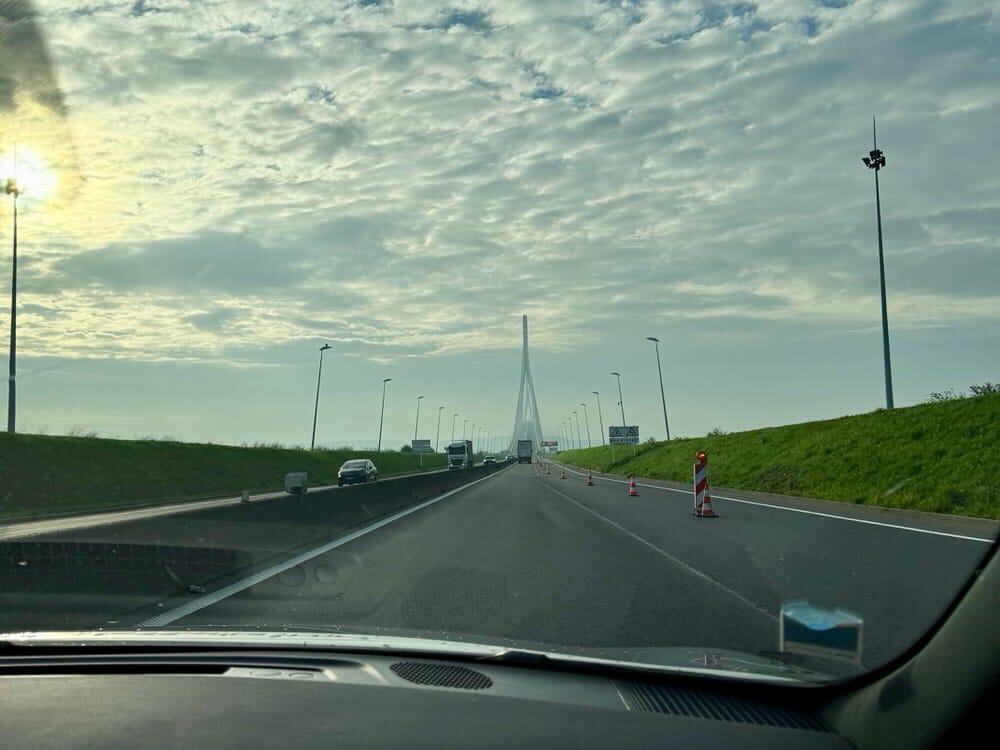
French speed limits are quite high. On the motorways the speed limit is usually 130 km per hour; that’s 80 mph! And that’s because that’s the absolute max that they want you to go. I usually found myself cruising down the autoroutes at about 115 kph and was pretty much keeping pace with traffic.
France uses radar to monitor speeding, so don’t think you got away with something if you cruised down the autoroute at 145 kph and never got pulled over. There might be an expensive ticket headed your way a few weeks after you get home from your fabulous French vacation.
When Driving in France How Do I . . .
Pay tolls
There are three main ways to pay tolls in France:
- A motorway pass called Liber-T
- A credit card or mobile pay
- Cash
If you’re driving a rental car, the pass isn’t going to be a convenient option. Even a month-long road trip through France probably isn’t worth the hassle of purchasing an electronic toll payment badge.
I think your best option is to have mobile pay set up on your phone. That way you can just hover your phone over the contactless pay area of the toll booth and in just a second or two your payment will be accepted and you’ll be on your way. It’s not quite automatic, but it’s pretty dang close.
If you have a chip card, you can also use that to pay. We did find that French toll booths didn’t care for our American Express, but had no problems with any of our chipped VISA cards.
When you approach a toll booth, you’ll see that lanes have overhead symbols that show which payments are accepted in each lane. A big lower case “T” indicates lanes for cars equipped with toll passes.
If you’re paying with cash, head to the lane with a sign showing coins and the Euro symbol. The cash lines are set up to accept coins and bills up to 20 euros. Just a note: all the toll booths we went through were unmanned, so you’ll be inserting coins and bills into a machine.
For card payments, you can head either to the lanes with an icon depicting a hand holding a couple credit cards, or you can also head to the cash lane, since the cash lanes also have a contactless pay option.
Pro tip: When you head through your first toll, I strongly recommend going to the cash lane even if you’re planning to pay with a chip card or mobile pay. That way if none of your credit cards work, you can always just pay with good old-fashioned cash.
Gas up
I was assured that all gas pumps in France take mobile pay, but that simply was not the case. We needed to gas up twice and both times ended up at pumps that only had traditional card readers. Maybe other parts of France have fancier gas pumps, maybe we just had bad luck, but we found only old school gas pumps in Normandy.
The actual act of filling up your gas tank once you’ve gotten your credit card to work is quite simple. Just make sure that you put the right fuel in your tank. Confusingly, “gazole” = diesel, while “sans plomb” = unleaded gasoline.
If you completely forget this information, check inside the flap covering your fuel tank to see if there’s info about what fuel the vehicle takes. When we picked up our rental car, the agent made a special point of telling us what fuel to put in the car, but it felt really nice to double check at the gas station.
One thing we did notice is that gas stations aren’t nearly as ubiquitous in France as they are in the United States. There are “aires de service” along the autoroutes about every 60 miles. These rest areas have convenience stores, restrooms, and sometimes even full-service restaurants. They usually, but don’t always have gas.
Apple maps also really struggled to identify nearby gas stations. In general, gas stations are located on the outskirts of towns. The advantage of gassing up at a small village gas station is that you can just go inside and pay the attendant if you’re struggling to get a credit card to work at the pump.
Pro tip: I highly recommend gassing up a little earlier than you normally would just to avoid stress.
Go through a roundabout
Although still pretty uncommon in the United States, roundabouts are no longer the terror-inducing mystery to Americans that they once were. In fact, here in Minnesota, highway engineers are increasingly replacing confusing four-way stop intersections with roundabouts. I for one am here for it!
If you feel unfamiliar with roundabouts before your French road trip, by the time you return your rental car, you’ll be an absolute pro. To enter a roundabout, you simply yield to traffic that’s already in the roundabout and then turn right into it when it’s safe to enter. Remember to signal when you reach your turnoff so entering traffic knows that they can turn in front of you.
If you’re using navigation on your phone, your phone will often announce which number exit you need to take. For example, “Enter the roundabout and take the third exit.” I found it very helpful to count the exits as I went around the roundabout to ensure I got off at the right one. That said, if you miss your exit, no need to panic. Just do a full rotation and hit it the next time.
Know when to yield
There’s no denying that some of France’s rural country lanes are pretty teeny. When you get into towns, the roads can often narrow to one lane, especially if cars are parked along (or in many cases partially on) the sidewalk. Naturally these situations make me very nervous.
However, most French drivers are pretty relaxed folks who will pause for a moment to let you around a parked car. It’s generally expected that if you’re in the midst of a one-way situation, you’ll continue. Not unlike the one-way bridges on the north end of Kauai, the French just make these “one car only” situations work. There’s really no reason to worry about them ahead of time.
One thing we noticed is that on one-way bridges, especially near the D-Day beaches, there were markings right on the pavement that told you if you had the right-of-way or needed to yield to oncoming traffic.
Obviously it’s a good idea to acquaint yourself with French road signs before your trip.
My Best Advice for Driving in France
Know where to expect street signs and traffic signals
When you drive on the French autoroutes, you’ll notice a few differences in signage (i.e. the signs are blue instead of green) but for the most part, signs are in the exact same spots as they would be if you were driving on an American freeway.
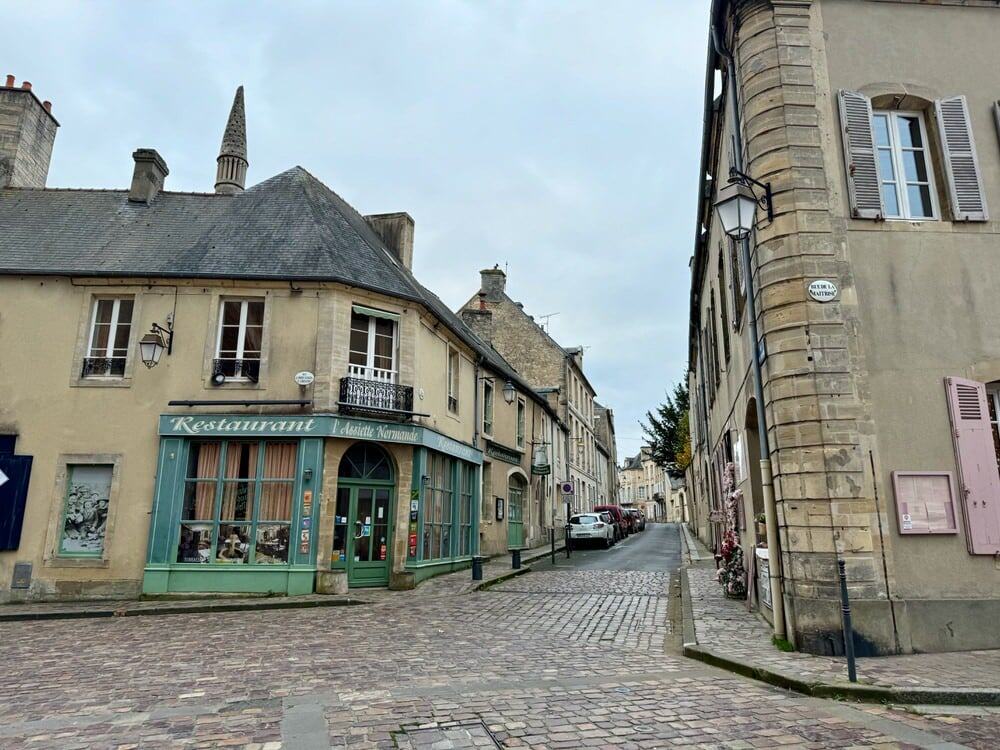
But once you’re in town, signage needs to adapt to pre-automobile infrastructure. As a result, street signs are often plaques right on the sides of buildings, usually at the second story level, about 10 feet off the road.
Conversely, traffic lights can (but aren’t always!) quite low. If you don’t see a traffic light at an intersection, be sure to check for one at eye level on the righthand side of the road. You don’t want to accidentally breeze into the middle of an intersection when you shouldn’t!
Skip Paris
Sure, you can rent a car in Paris, but I’m not really sure why you’d want to? Between the metro, Ubers, and taxis, not to mention easily accessible train stations to get you out into greater France, I don’t see any advantage to having your own car in Paris. I definitely recommend getting out of Paris into the open country before picking up your rental car.
In general, it’s best to opt for tolls
Maybe these are fighting words as I know for many people avoiding the autoroute (or “peage” roads) is a source of pride, but I for one would take paying an extra 6 euros a day over spending half an hour covering 9 miles of windy, country roads. (As an American, I think you should be able to travel at least 50 miles per hour and nothing will dissuade me from this belief.)
Apple Maps was hellbent on saving me money by avoiding all toll roads. By about the midpoint of driving in France, I was over it. At least in Normandy, taking the country roads over the autoroute can add hours of driving to your day since you will be going through near constant roundabouts and slowing down approximately every 5 minutes for a village.
To me, avoiding toll roads felt like the definition of “penny wise, pound foolish.” I’d much rather just get to where I want to go than waste half the day cruising the scenic, but repetitive French countryside.
Double check your route before a long-haul drive
Apple Maps worked great for getting us all over Normandy, but it’s not without its quirks. As a result, I started charting out our route for the next day on Google so I’d have a general idea of which roads we’d be using. This was especially important since I was the driver, not the navigator, so I couldn’t double check things in the moment if they seemed “off.”
One example of Apple Maps’ navigational head scratchers was that when we were driving back to Rouen, Apple Maps (seemingly) arbitrarily directed me to take an exit for another autoroute and then, while still on that exit, merge back onto the autoroute I was already driving on.
Luckily, because I’d taken a minute to look at the route the night before, I knew I wanted to stay on the road I was already on and could dismiss this mystifying direction in the moment. If I hadn’t had any idea of what roads I was supposed to be on, I probably would have just blindly followed the instruction.
Parking
One thing I always tried to do before we started driving was have a plan for where I would be parking next. I found Apple Maps was pretty accurate when it came to finding public parking lots in Normandy. It definitely eliminated a lot of frustration to have our directions set to get us all the way to a parking space instead of just the center of town
The only place where parking really fell apart for us was in Etretat. This small seaside town is a notorious parking nightmare and even with planning ahead, we fell victim to Etretat’s absolute public parking disaster. Driving in circles through downtown Etretat just seems to be a rite-of-passage for tourists here. (The parking lot both Andy and I found on our maps was in the middle of being dug up.)
Pro tip: A lot of parking in France’s urban areas is underground. If you’re struggling to spot a parking garage, it might be underneath you.
How Much Does It Cost To Drive A Car in France
Here’s how our car rental costs shook out. All costs have been converted to USD.
- Week long rental of mid-size SUV (picking up and renting in Rouen): $357.08
- Tolls: $23.39 (4 tolls, including the Pont de Normandie)
- Petrol/gas: $143.59
- Parking: $8.48
- Total: $532.54
Maybe because it was the off-season, we found ample free parking everywhere we went. To be completely transparent, many of the pay stations had been turned off for the winter.
Although I’d been warned that tolls are quite high in France, I found them infrequent enough that I really didn’t mind paying them, especially in exchange for such well-maintained roads. Honestly, there probably isn’t even a French word for “pothole!”
We rented our car through Enterprise and had a really good experience. I’m sure you could save a buck by renting through a smaller, more local agency, but Enterprise was extremely easy and efficient to deal with.
I didn’t feel I needed to take photos of the car’s exterior before I drove off the lot to use to settle disputes about claimed damage to the vehicle when I returned the car. Happily I didn’t put a scratch in the car and returning the car after having it for a week took just a couple minutes.
Would I Drive in France Again?
Absolutely! Honestly, in many ways, I thought driving in France was far easier than driving in the United States. The roads are amazingly well-maintained and I really can’t stress how courteous and kind French drivers are. With roundabouts galore, ample public parking, and easy to pay tolls, the country is really set up for efficient road tripping.
Personally, the unexpected downside of driving in France for me was that it took a lot of my energy. It’s stressful to always be thinking about navigation, where you’re going to park, when to gas up, etc. While my passenger really got to enjoy the pastoral scenery of Normandy, I was often too worried about my next turn to soak up the landscapes.
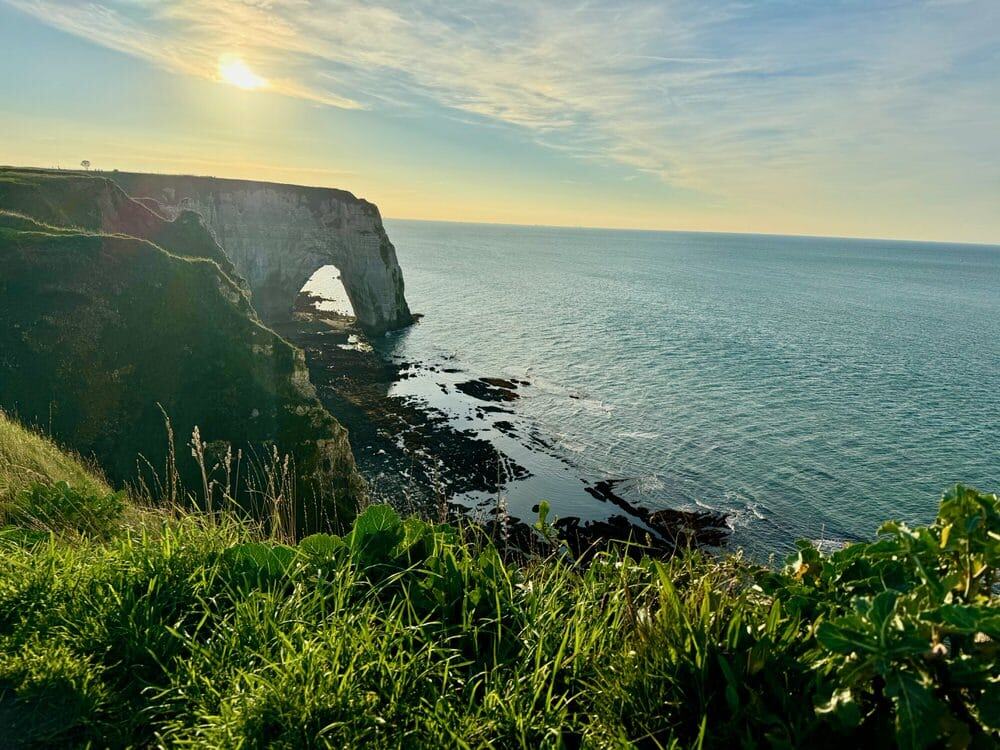
Although I really missed having the free time that you get from public transportation, I’m so grateful we did opt to drive through northern France. Our rental car got us to some amazing sites like the Cliffs of Etretat and seal colony in the Bay of Somme that we never would have reached if we’d only used public transportation.
Conclusion: Everything You Need To Know To Successfully Drive in France
If I hadn’t overcome my fear of driving in a foreign country, we would have missed so many amazing sites in France. From Mt. St. Michel to the Thiepval Memorial, our experience in northern France simply wouldn’t have been possible without a car.
Happily, greater France is set up very well for car travel. While I would never recommend driving in Paris, I found driving in France to be extremely intuitive, even with road signs in a foreign language.
My best tips if you’re looking to do a road trip in France is to have mobile pay set up on your phone for tolls and parking, making sure you rent an automatic transmission if you prefer them, double checking your route before you set out and always having a plan for parking. If you have the benefit of a hands-on navigator in the passenger’s seat, your road trip will be a breeze!
I hope this post helped qualm any worries you have about driving in France and helped you hone up on specific French driving laws. I really can’t stress how easy it was to navigate French roads and towns independently in a rental car. Since drivers in Normandy were laidback and considerate, even driving in larger cities like Rouen and Caen wasn’t particularly stressful.
If you have any other specific questions you’d like answered about driving in France, just send me an email. I’m happy to share any insight you might be looking for.
 |
 |