

This post may contain affiliate links. When you purchase something through these links, I receive a small commission that helps me create this blog’s content. There’s no extra cost to you. Read my privacy policy to learn more.
Published: 2/13/2024
The Ultimate Azores Travel Guide for First-Time Visitors
If you’re consider a trip to Portugal’s Azores or are just wondering what the heck the Azores are, this travel guide is for you!
For years I’ve been trying to convince pretty much everyone I know to take a trip with me to Portugal‘s subtropical islands in the middle of the north Atlantic Ocean.
Despite gaining popularity in recent years thanks in part to some airline advertising campaigns, many people aren’t familiar enough with the Azores to gamble their precious vacation time on this seriously underrated destination. But I’m here to change that!
With this Azores travel guide I’ll answer all your questions about these beautiful European islands. I’ll explain what the Azores are, where they’re located, a brief history of the Azores, the logistics of getting to and around the Azores, and how to choose which of the nine islands to visit. We’ll even talk about how the islands got their name.
So let’s dive right in and learn all about Portugal’s Azores.

What are the Azores?
Often referred to as Europe’s Hawaii, the Azores are located in the middle of the North Atlantic Ocean. These nine volcanic islands sit between 950 – 1400 miles west of Portuguese mainland. You can get there with an approximately 4.5 hours flight from both Boston and Frankfurt, Germany. There’s some speculation that these remote islands are the Atlantis of ancient mythology.
The Azores operate as an autonomous region of Portugal. While Azoreans identify as Portuguese, they have their own government, accent, and cultural identity. In many ways, they are to Portugal what an American state is to the United States.
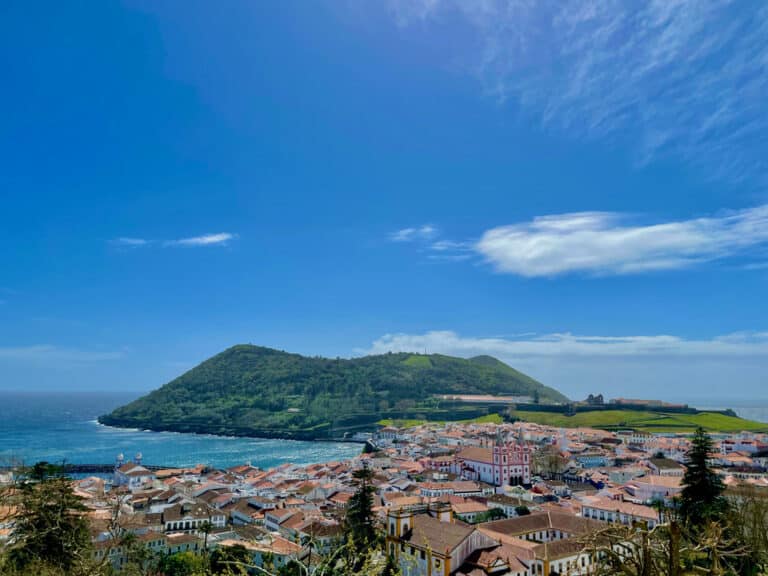
The islands were uninhabited until trade winds blew Portuguese sailors into Angra do Heroismo’s harbor on Terceira Island in the 1400s. Because of their strategic position in between the Americas and Europe, the Azores played an important role in the days of ocean exploration and trade.

When airplanes still needed to refuel for transatlantic flights, Terceira Island was a common refueling point. Because of this Americans took over the island’s Lajes Air Base from the British during World War II. An average of four emergency landings – usually from medical emergencies on transatlantic flights – still take place each month at Lajes Airfield.
The Azores can also make a convenient meeting point for American and European leaders. Did you know the decision to invade Iraq in 2003 was made in the Azores?!
Historically, the Azores were very poor. Residents mainly farmed and whaled. Many, looking to escape a subsistence lifestyle immigrated to the Boston area. (If you’re ever looking for Azorean cuisine in the U.S., check out Boston!)
These days, the islands’ main industry is tourism. In addition to pimping out their gorgeous landscape, the Azores are still known for agriculture, especially cattle and dairy. Because of their unique temperate climate, you can grow just about anything in the Azores including tropical fruits and tea.
Where Are The Azores?

Why You Should Visit the Azores
You’ll often hear that the Azores feel like Hawaii and Ireland’s love child. Since both Hawaii and Ireland have special places in my heart, I can assure you that this description is very accurate!
The island hopping and the distinct personalities of each Azorean Island definitely reminded me of Hawaii. While the gulf stream allows tropical plants like palm trees to grow in the Azores, the actual appearance of the Azores, with its the rugged coastline and pastoral hillsides, more closely resembles Ireland.
The Azores’ unique position in the world in and of itself attracts visitors, but the islands offer a lot more than just travel bragging rights.
For outdoor enthusiasts, all nine of the major Azores offer extensive hiking opportunities. As you might expect, you can also expect excellent fishing and whale watching.
The Azores’ unique geography offers endless dramatic vistas perfect for amateur and professional photographers. With geothermal energy literally oozing out of the islands, you’ll find lots of unique bathing opportunities, including ocean pools warmed by geothermal springs. (I’ll admit geothermal travel is a weird niche, but I did go on another geothermal adventure in Alaska . . . .)
Culture lovers will enjoy the Azores’ rich human history. Those escaping persecution in Europe sometimes ended up in the Azores which contributes to the islands’ distinctive culture and cuisine.
And if you want to sip some of the most unique wine in the world, you need to get to the Azores. Because the Azores (like other places on the Atlantic) can experience hurricanes, the grapes must be harvested early to avoid crop destruction. The result is a very dry, slightly salty wine.
Although Azorean wine is somewhat maligned, especially when compared with wine from mainland Portugal, I loved it! It also makes a great Azores souvenir!
Seriously, the Azores offer so much that one visit really isn’t enough to do this special corner of the world justice.

What To Know Before Visiting the Azores
No Azores travel guide would be complete without all of the need-to-know Azores information to help you plan your trip.

How To Get to the Azores
Unless you own a yacht (I do not . . . but the Azores are a popular destination for yachters!), you’re probably get to the Azores via either a cruise ship or an airplane. If you want the most control of your time in the Azores, your best bet is to fly.

You’ll find direct flights to the Azores’ largest city – Ponta Delgada on Sao Miguel Island – from New York City, Boston, and Toronto. You get a lot more flight options from the European side of the pond. Various airlines offer direct flights to the Azores from Frankfurt, Lisbon, London, Manchester, and Porto.
Many people opt to visit the Azores as a stopover on a larger European itinerary. Alternately, you might find more affordable flight options by flying first to Lisbon or Porto and having a mainland Portugal stopover before continuing to the Azores.
We opted to book our trip through Azores Getaways, a travel agency that offers flight and lodging packages. For the best rate, we booked separate flights to Boston where we caught our flight to Ponta Delgada. After a six-hour layover in the Azores’ capital city, we finally made it to our final destination: Terceira Island.

Weather in the Azores
Azoreans are fond of saying they have “all four seasons in one day.” As a Minnesotan, I strongly disagree with the sentiment, but their point is taken.
Don’t expect tropical weather on the Azores. While the gulf stream keeps the islands warm year-round, it also means the islands never really get hot. You can expect temperatures to stay above 50 degrees and below 80 degrees year-round.
During our March visit, we found the weather very similar to Ireland’s spring weather: think gusty winds and frequent rain showers followed by rainbows. While you might be absolutely buried in fog at the island’s high points, you often only need to drive 10 minutes to find blue skies.
Moral of the story: always wear layers and have a rain jacket within reach!

About the name “Azores”
In English, “Azores” looks an awful lot like “Azure.” For a long time, I assumed Azore was the Portuguese word for this blue color. I mean, it seemed like a fitting enough name for islands in the middle of the wide blue ocean . . .
But when you’re in the Azores, you’ll quickly realize that the islands’ name is actually Açores. Because we don’t use cedillas in English, the islands’ name is Anglicized to “Azores.” Instead of the harsh “A-zoar-s”, you pronounce Açores like “A-sores,” with a little extra “z” sound on the “s.”
In Portuguese, an açor is a northern goshawk. When the Portuguese reached the Azores, they saw a raptor soaring above the islands and decided to name the islands for it. However, they misidentified the bird. (There are absolutely zero goshawks on the Azores.) They probably spied a buzzard or kite.
Despite the mistake, the name stuck. You’ll even find a goshawk on the Azorean flag. The popular Azores distillery, Goshawk, continue to honor the islands’ misnomer name.

Getting Around the Azores
To get around the Azores, we depended on planes and cars. During the summer months, you also have an option to take a ferry between the Azores’ nine major islands. Since we visited in the early spring, flights were our only way to get from island to island.
Driving in the Azores
Once you’ve arrived on the island of your choice in the Azores, you’ll want a car.
If you don’t have a set of wheels during your time on the islands, you’re seriously going to miss out or be very beholden to tour bus itineraries. The Azores are pretty rural and there’s really no public transportation.
Happily, our Azores Getaways package also included a car rental on both Terceira and Sao Miguel Islands.
While I can’t speak from personal experience since Jenny drove us everywhere, driving in the Azores seemed pretty straightforward. While the endless roundabouts are no joke (Jenny even got us through an interesting triangle roundabout in Angra!), compared to driving in Hawaii, the traffic was very manageable. We often had the roads to ourselves.
How to Choose Which Island To Go to in the Azores
Just like with Hawaii, which islands you visit in the Azores will have a dramatic impact on your experience and impressions of the region.
For example, Pico Island is the island best known for producing wine. Terceira Island is home to the oldest city in the Azores – Angra do Heroismo. Sao Miguel is both the largest and most populous island in the Azores. If you only visit one island in the Azores it will likely be Sao Miguel, if only for a flight connection.
The islands are often divided into the three groups: Eastern, Central, and Western.
We took the easy route when it came to choosing which of the Azores to visit. Instead of hemming and hawing over the merits of each island, we simply accepted the itinerary presented by Azores Getaways. We ended up with three nights on Terceira and four nights on Sao Miguel.
While I would have loved to have seen Pico and Faial Islands, our 8-day Azores itinerary on Terceira and Sao Miguel Islands was the perfect introduction to the Azores.
 |
 |