

This post may contain affiliate links. When you purchase something through these links, I receive a small commission that helps me create this blog’s content. There’s no extra cost to you. Read my privacy policy to learn more.
Published: 4/19/2025
What To Eat and Drink at the European Christmas Markets
Before I traveled to the European Christmas markets in December 2024, I tried to look up some of the foods and drinks I should definitely sample during my week-long visit. As a food lover and a planner, I hoped I could find a checklist of popular Christmas market food specialties well worth the euros and calories.
However, what I generally got was a bunch of mumbo jumbo about how food offerings vary greatly from market to market. General consensus said it’s best to wander through the market stalls and order whatever looks good. While I respect this approach, I don’t speak German and barely speak French. I wanted at least a general idea of what I was ordering and then eating, no matter how tasty it appeared.
So I decided to create this guide to the most common European Christmas market foods we found at some of the most popular markets in France’s Alsace region, Switzerland, and southern Germany.
There are definitely commonalities when it comes to food offerings. While some foods like gluhwein and bratswurst really need no introduction, other foods like opfelchuechli and schupfnudeln I wasn’t willing to order until I knew what it was.
I had so much fun sampling all the different Christmas market foods to create this definitive list of foods to try during your European Christmas adventure. Read on to learn about the best food and drink to try at the Christmas markets in France, Germany, and Switzerland. You’ll also see why it’s not the worst idea to pack a high fiber breakfast!
You don’t want to be trying to use Google Translate in the middle of the busy markets! Bookmark this guide for easy reference when you’re at the markets and feeling peckish.
20 Most Popular European Christmas Market Foods
1) Gluhwein (Mulled wine)
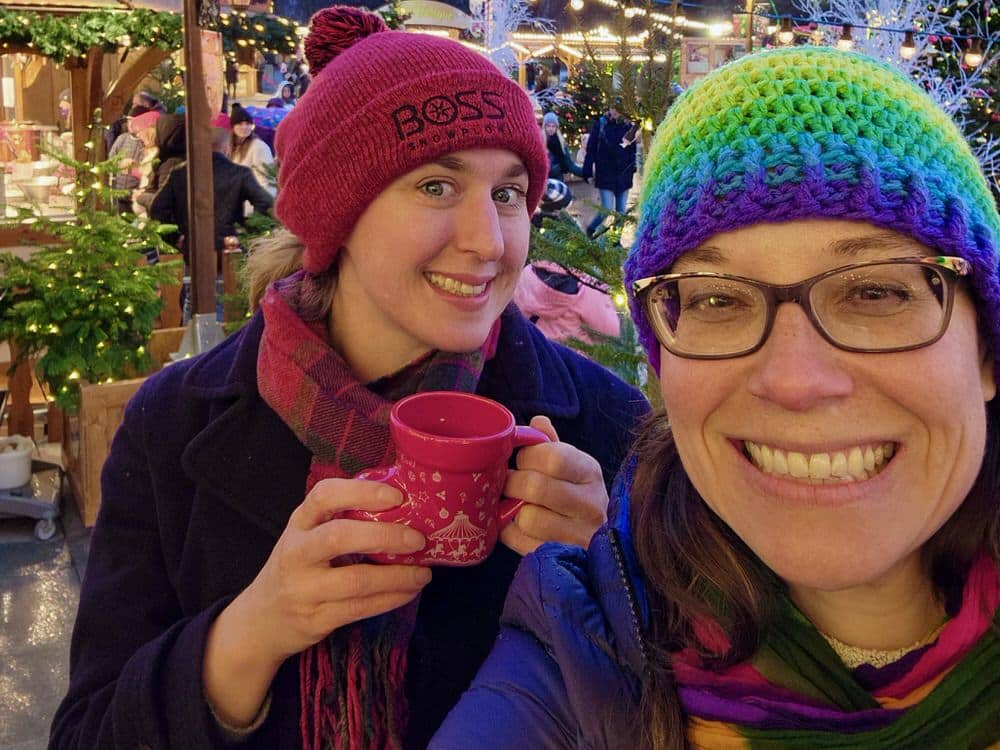
Let’s start with the big one: gluhwein! Called vin chaud in France, this hot spiced wine flavored with cinnamon, anise, cloves, citrus peel, and either honey or sugar is synonymous with the Christmas markets. Basically every other person you see in the markets will be sipping from a gluhwein mug.
While gluhwein is most commonly made with red wine, you can usually also find white wine gluhwein (which I personally prefer) and sometimes even gluhwein rosé. Additionally, you can sometimes pay extra to fortify your gluhwein with extra alcohol like brandy or rum.
The most fun way to add a little extra booze to your drink is by ordering a feuerzangenbowle. For this drink, a sugar cube soaked in rum is perched over a mug of gluhwein and lit on fire. As the sugar burns, it melts into the wine. It’s a drink and show all in one mug!
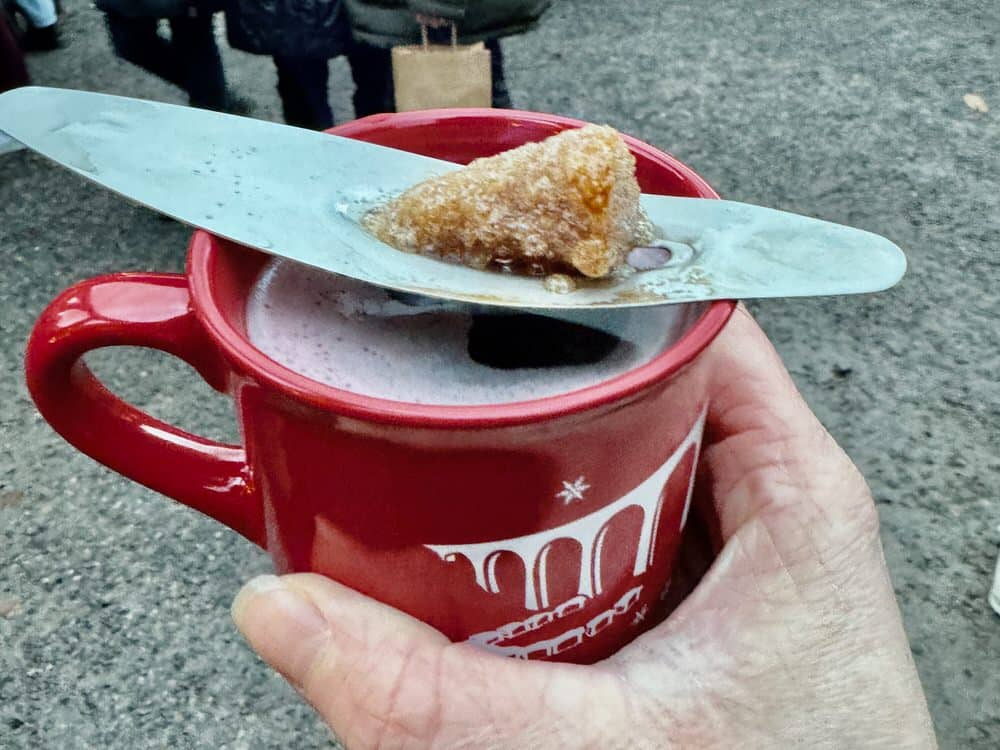
Of course, a Christmas market activity that’s possibly more beloved than actually drinking gluhwein is collecting the mugs they come in! Most markets in Switzerland and Germany serve gluhwein in personalized ceramic mugs. (France is often bemoaned for serving their vin chaud in plastic glasses.) When you order your first mug of mulled wine, you pay a small deposit on top of the price of wine. When you finish your drink, you either refill the mug, keep it, or return it for your deposit back.
Don’t drink alcohol? No worries. You can still have the fun of collecting gluhwein mugs and a spicy warm beverage. Just order the kinderpunsch or kindergluhwein. This is made with a blend of fruit juices and gluhwein spices. Alternatively, some stands also offer hot apple cider and hot chocolate in the collectable mugs.
2) Raclette
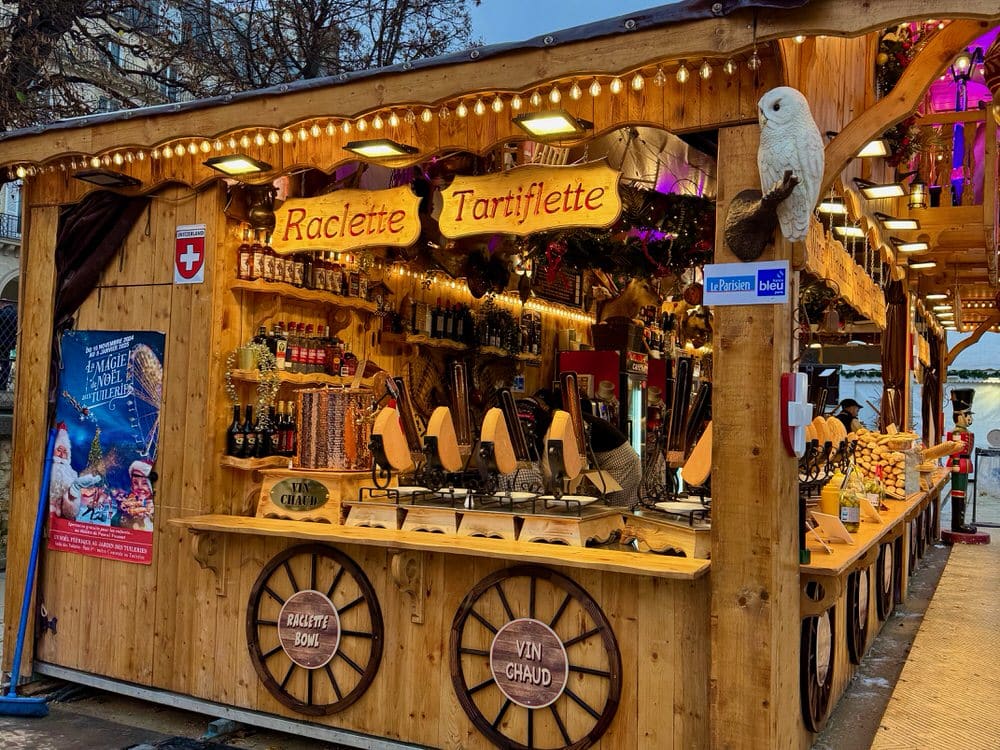
After gluhwein, the food that probably comes to mind when you think of Christmas markets is raclette cheese. This stinky, delicious Swiss cheese is melted or grilled and then served in a variety of ways. At the markets, the melted cheese is usually scrapped onto a baguette and enjoyed as a melty sandwich. While the cheese and bread pairing is delicious on its own, a raclette sandwich often includes pickles, ham, and Dijon mustard.
3) Wursts (sausages)
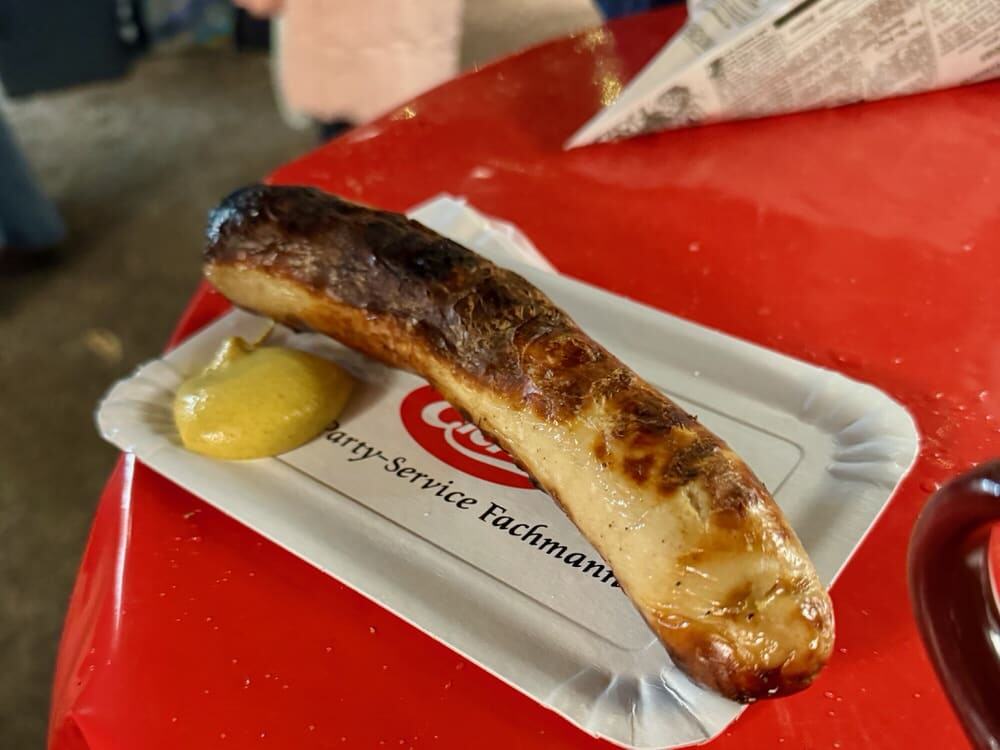
Every Christmas market we visited had at least one large grill area where you can choose from a wide variety of sausages including hot dogs and wursts. It’s an easy and tasty protein option to keep your energy up while you shop.
Some common sausage you’ll find at the markets include:
Weisswurst – a mild sausage made with pork and veal seasoned with what Midwesterners would consider traditional “brat” flavors like lemon, nutmeg, and pepper.
Kalbswurst – veal sausage
Rauchwurst – smoked sausage
Curry Wurst – a sliced sausage served with a curry sauce
Knackwurst – pork and beef sausage flavored with garlic and grilled until the skin is crispy.
You can get the wurst of your choosing in a bun, but they often come with a piece of rye bread and a healthy blob of mustard. While ketchup use is generally poo-pooed, there’s usually a condiment station (including ketchup and mustard) to the side of the grill area where you order.
4) Crepes
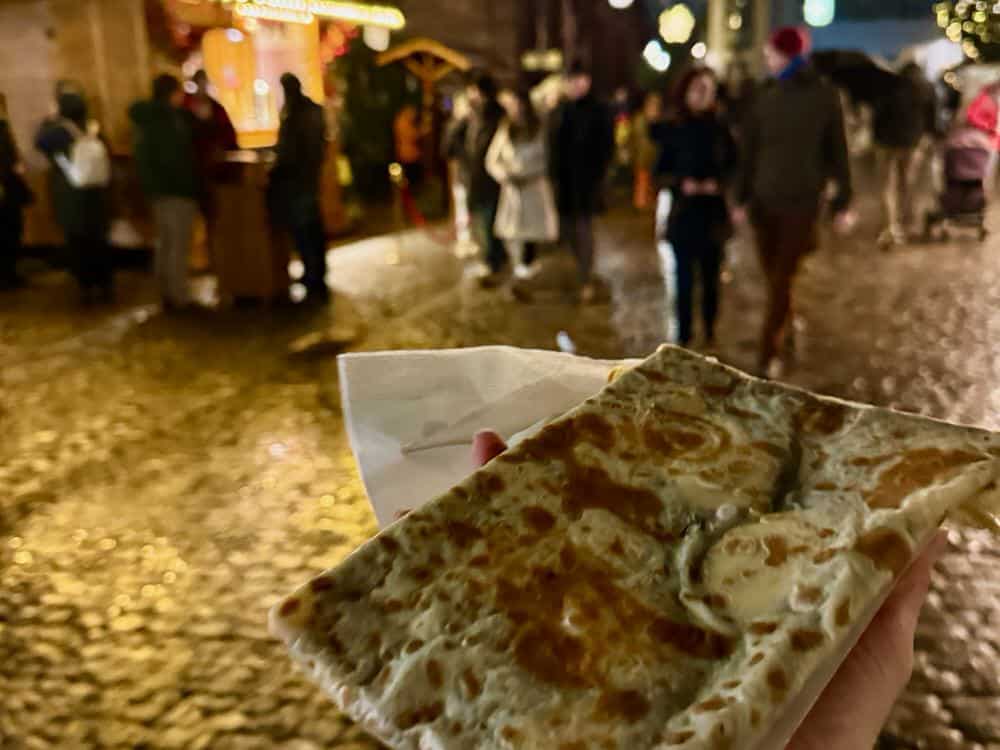
Whether you’re at Mont St. Michel in northern France or a plaza in Switzerland, crepes are a popular European street food year-round. It’s no surprise that they’re a common offering at the Christmas markets. In fact, I’m not sure we went to a Christmas market that didn’t have at least one crepe stand.
You can fill these large, thin pancakes with all sorts of different flavors. While jam, whipped cream, sugar, and lemon are among the traditional flavors, my personal favorites are Nutella and banana. If you’re not a huge crepe fan, these stands usually seem to also offer waffles with the same toppings.
5) Tartiflette
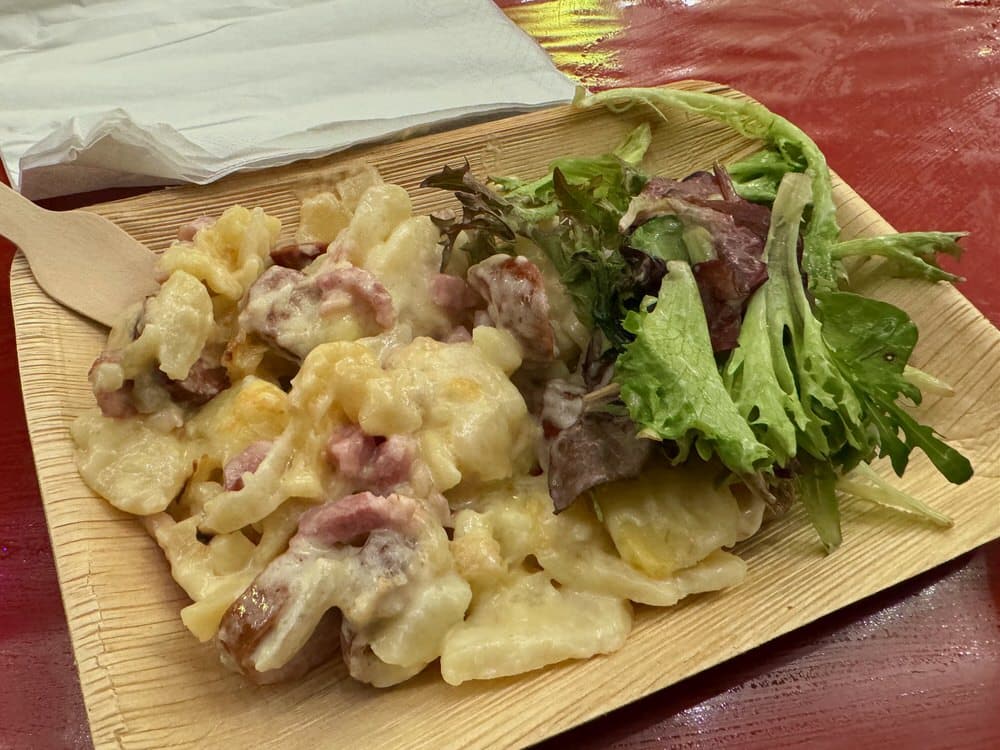
At the Christmas markets, you’re bound to find at least one booth serving up a vat of tartiflette. Not quite stew, not quite casserole, this cozy potato dish is made with sliced potatoes, melted cheese (traditionally the semi-soft Reblochon), and flecks of bacon, onion, and garlic. This is stick-to-your-ribs mountain fare and it tastes as good at the end of a rainy day exploring the Christmas markets as it does after skiing.
6) Schupfnudeln (Potato dumplings)
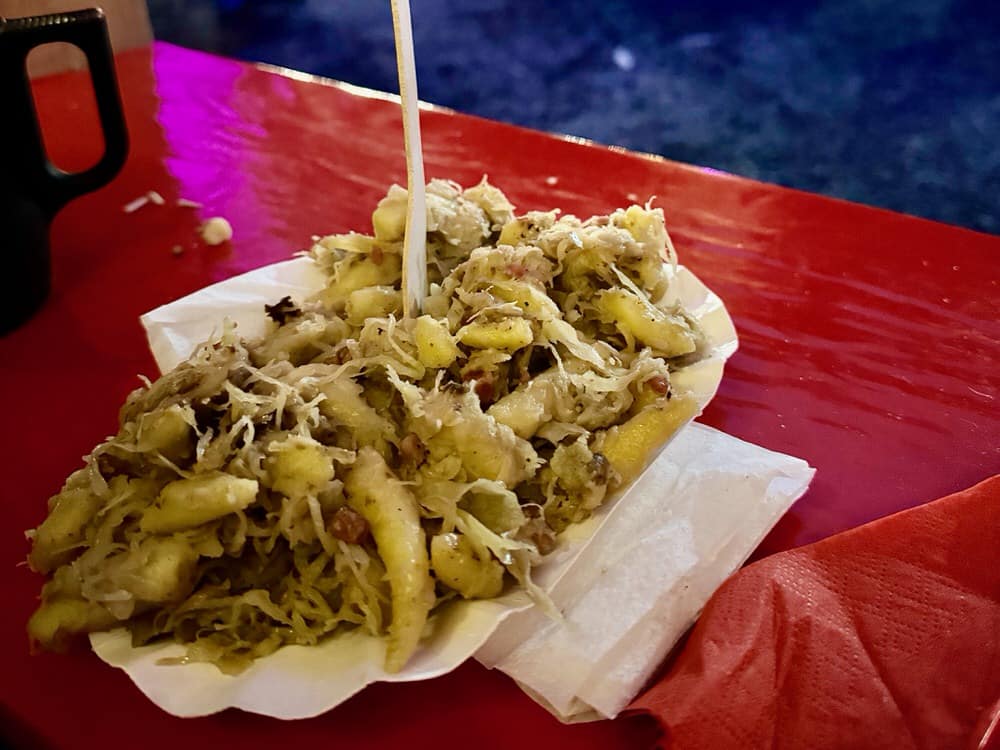
When Ashley and I saw people walking around the Ravenna Gorge Christmas market with plates of schupflnudeln, we thought they were eating french fries covered with sauerkraut. In actuality, these are soft potato dumplings topped with a generous dollop of sauerkraut and flecks of bacon known as “speck” in German. If you’re a sauerkraut lover, this is an excellent Christmas market dinner option.
7) Reilekuchen (Potato Fritters)
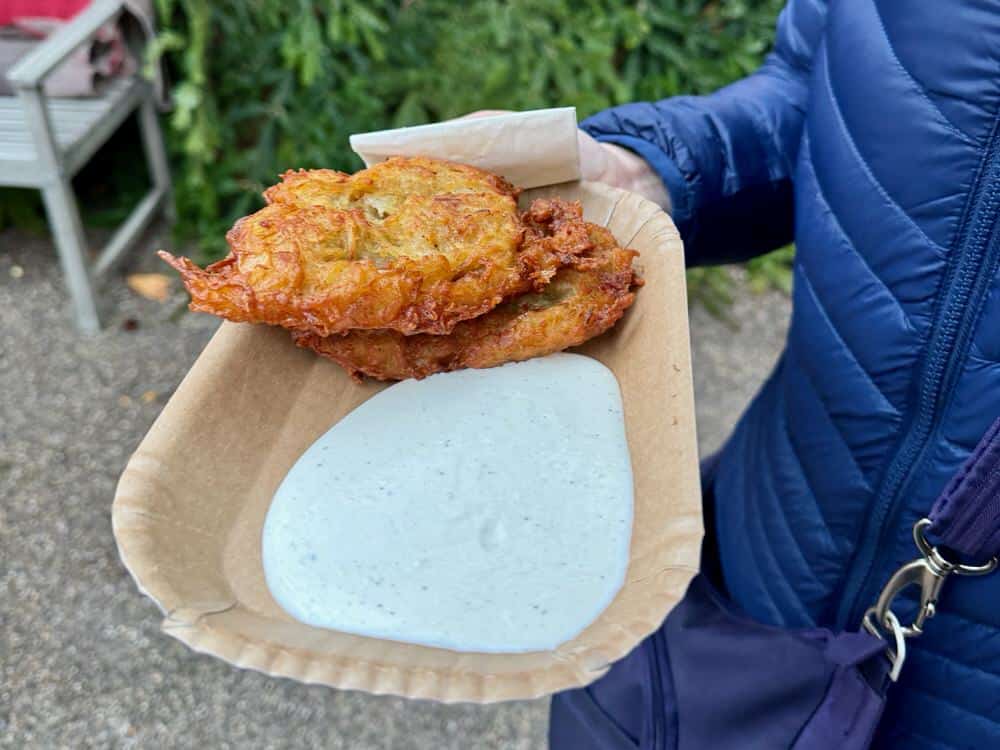
If you’re a fan of potatoes (and who isn’t?!) you’ll never go hungry at the Christmas markets! Reilekuchen is a thick potato fritter, much larger than either a potato pancake or latke. Crispy on the outside, soft in the middle, they’re traditionally served with apple or garlic sauce. When I asked the server what the better sauce was, she strongly recommended garlic.
8) Tornado potatoes
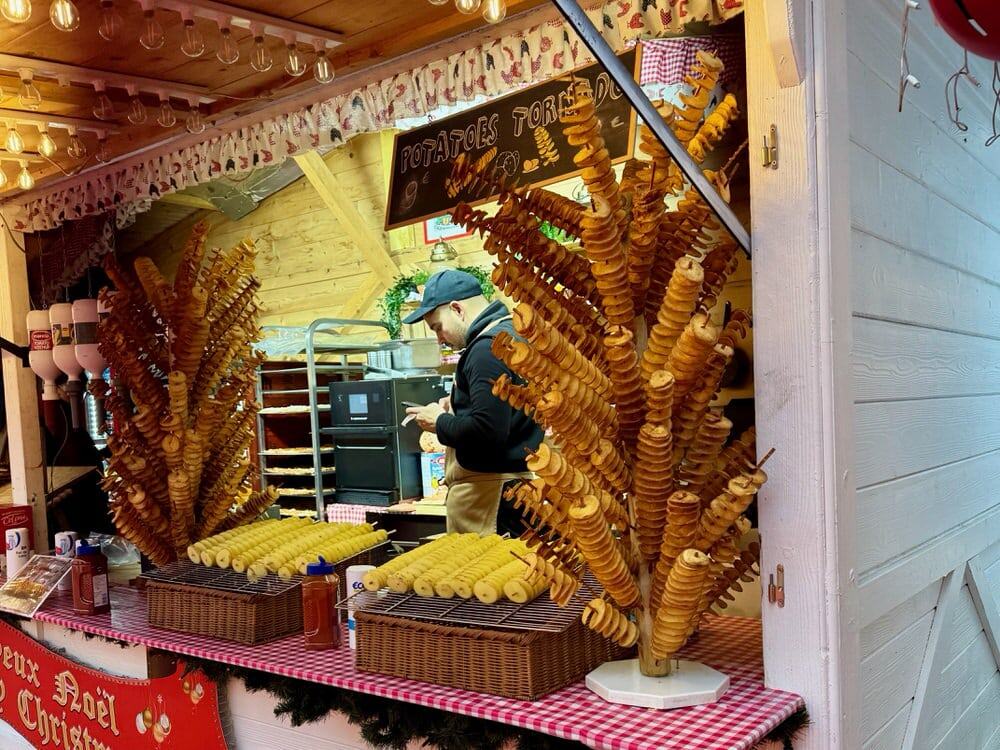
At some point in your Christmas market wanderings, you’ll come across a booth selling fried potato rounds on a stick. A tornado potato features a potato that’s been skewered, spiral cut, and deep fried to make a fun, pull apart street food. Although these potatoes, which originated in South Korea, are a little gimmicky, there’s no question that they’re also very tasty.
9) Käsespätzle
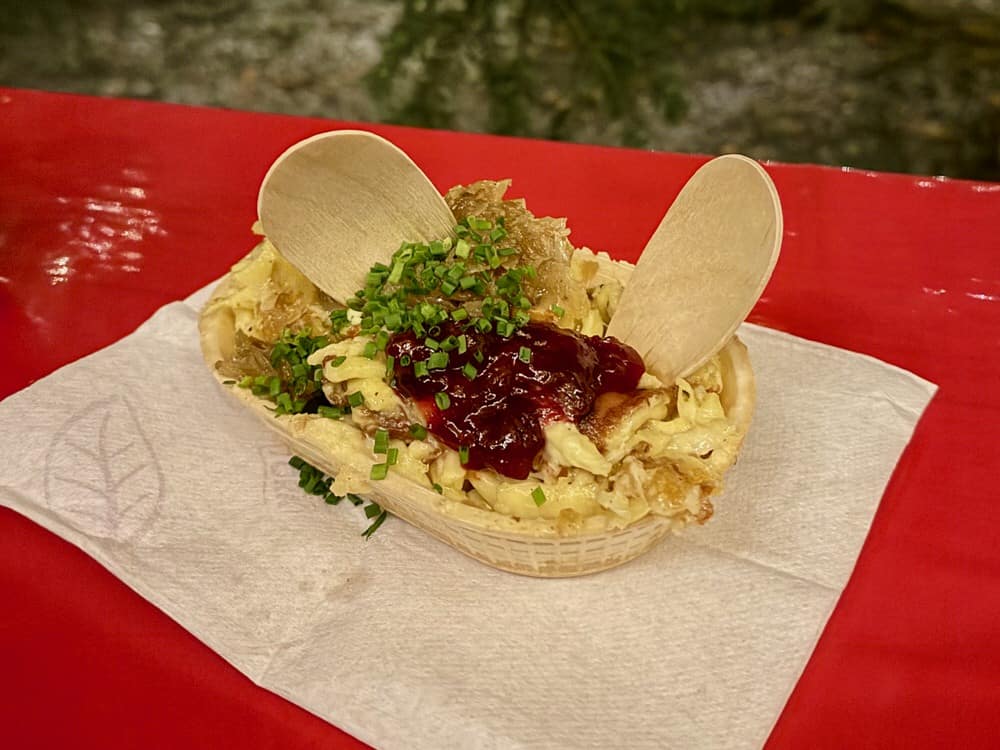
This German Christmas market main dish is basically mac and cheese, but with spätzle instead of noodles. While you could technically classify spätzle (sometimes you’ll see it spelled spaetzle) as a noodle, I’ve always thought of it as a tiny egg dumpling. In the case of käsespätzle, those little dumplings are mixed with a gooey, cheese sauce. It’s then topped with a generous sprinkle of chives and either caramelized onions or lingonberry sauce.
We opted for both toppings and it was honestly one of the very best things I ate during our full week at the Christmas markets.
10) Tarte flambée/ Flammkuchen
You won’t find pizza in the Christmas markets outside of Italy, but you’ll find plenty of booths offering tarte flambée or flammkuchen, a delicious flat bread that originated in the Rhine River valley. It features a simple bread base similar to a pizza crust that’s then topped with cheese, onions, and bacon. The bread is then baked in a wood fired oven which melts the cheese, caramelizes the onions, and singes the edges. Yum!!
Many booths also offer a vegetarian option which is my personal preference because every once in a while, a girl needs a break from ham and bacon, especially when traveling in Europe.
11) Maiskollen (Corn on the cob)
I was really surprised to discover that corn on the cob is a fairly common Christmas market treat, especially in Germany. Americans might be known for hamburgers and milk shakes, but corn on the cob is right up there for me on the list of “most American foods ever.”
Despite being a Midwesterner, I grew up far removed from middle America’s farmlands. I don’t consider corn on the cob much of a treat at home and I certainly didn’t fly across the globe to eat it in Europe. Still, if you have picky eaters in your group, this could be a good option to seek out.
12) Pretzels
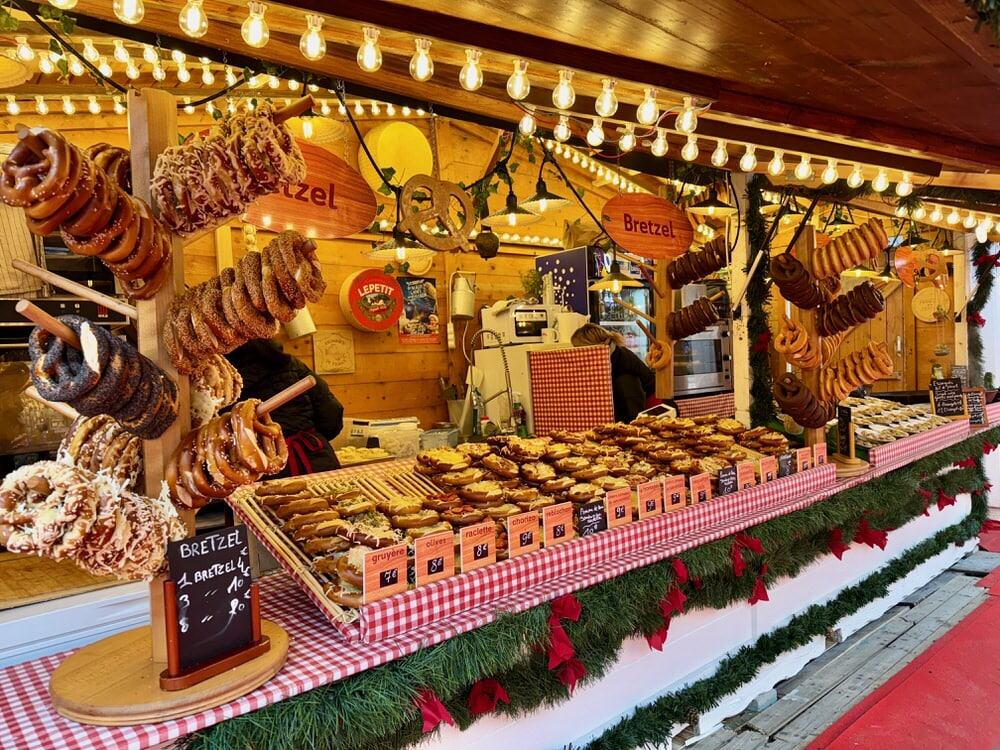
I’m not sure there’s a food I associate more with Germany than the pretzel. While they make me think Oktoberfest more than Christmas market, you can certainly eat your fill of pretzels at the European Christmas markets.
We’re not just talking the pretzel topped with flakey salt that you’ll find on a Manhattan street corner. Pretzels at the markets come in all sizes with a wide array of toppings from savory to sweet. Some favorite pretzel toppings include cheese, poppy seeds, olives, chorizo, cinnamon sugar, and of course, plain salt.
Fun fact: In Germany, pretzels are called “brezel,” which means “bracelet.”
13) Lebkuchen (Gingerbread)
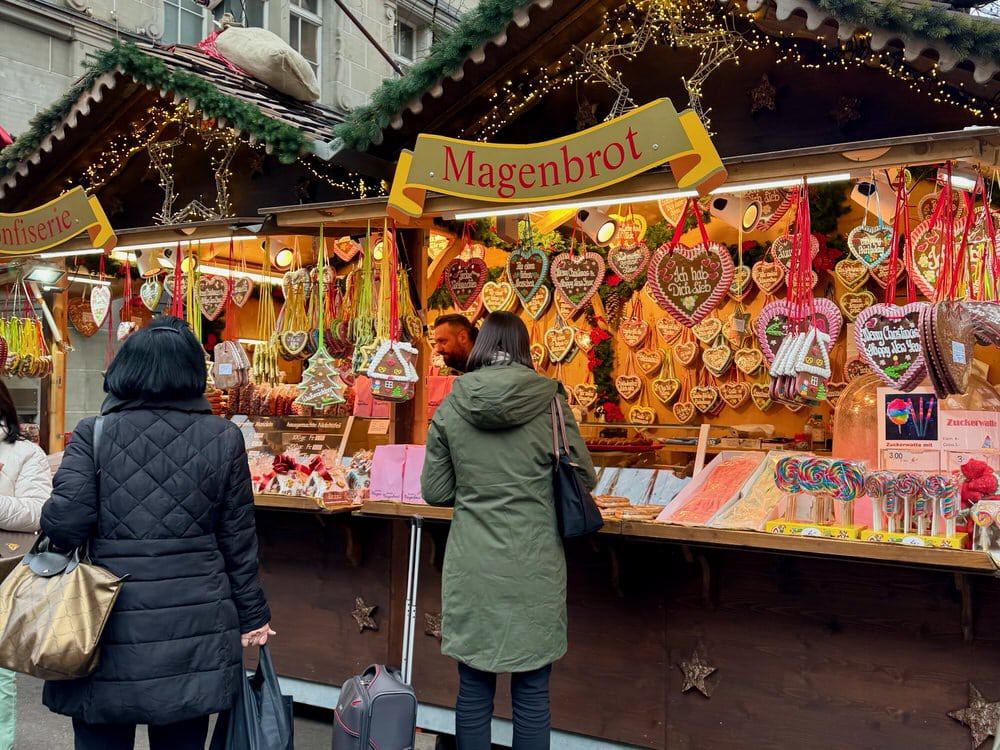
One of the most iconic Christmas market sights are large gingerbread cookie hearts decorated with icing hanging on brightly colored ribbons. These are lebkuchenherzen, a harder version of lebkuchen, a traditional German spiced honey cake.
While this attractive cookies don’t always earn high marks for flavor, they certainly make attractive holiday decorations. Just a word of warning: if you opt for a cookie with an icing inscription in German, you might want to run the phrase through Google Translate before buying to make sure it isn’t obscene!
Instead of the hard “eye candy” lebkuchenherzen hearts, you might prefer to buy actually lebkuchen, which is much softer and often comes in decorative tins perfect for gift giving. You could also try magenbrot, a small gingerbread biscuit that’s especially popular in Switzerland.
While I didn’t sample any actual lebkuchen during my Christmas market trip, you can find many lebkuchen flavored items. I bought a pack of lebkuchen loose leaf tea that received rave reviews from my parents.
14) Grattimanner or Grittibanz (Swiss bread men)
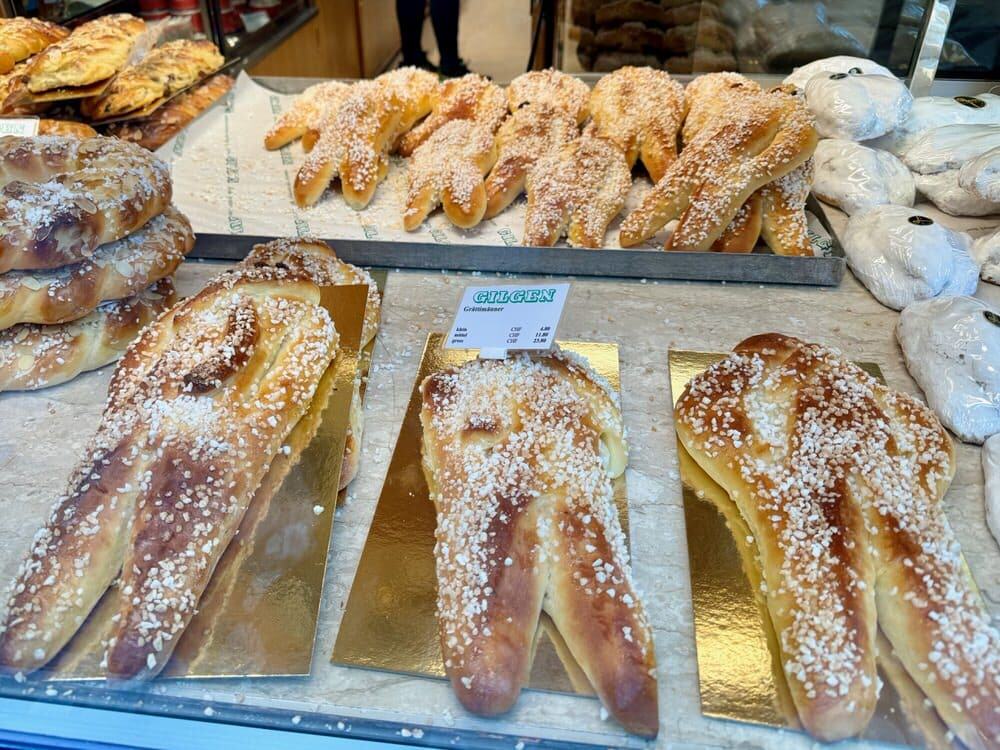
We were in Europe over St. Nicholas Day (December 6), right when Swiss bakeries start churning out these loosely man-shaped sweet rolls. Often they have raisins for eyes and sometimes, they’re holding a chocolate stick in their arms or mouth. While I’m not sure we ever saw them in the Christmas markets proper, they deserve a shoutout in this post because they were piled in every Swiss bakery window and grocery store we passed.
Made with an unflavored sweet dough and covered in pearl sugar, these are simple perfection. I was so bummed I waited until our last evening in Basel to buy one from the train station grocery store. They’re truly the perfect breakfast roll; not too sweet and pairs perfectly with coffee. You actually don’t have to travel to Switzerland to taste them. You can easily make them at home with this recipe.
15) Opfelchuechli (Fried apple rings)
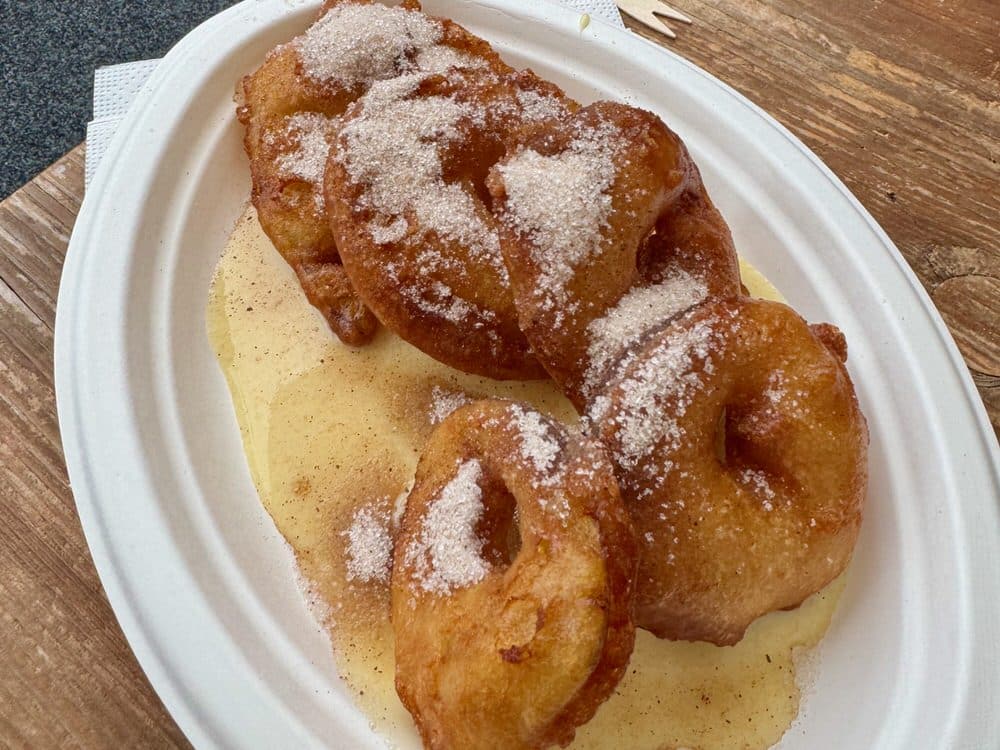
Apparently a Swiss specialty (at least according to the sign on the booth where I purchased them in Zurich), these apple rings coated in a light batter and fried were my personal favorite of all the foods we tried at the Christmas markets. Sprinkled with a little cinnamon sugar and served with a vanilla cream sauce, they were divine. They’re definitely giving “State Fair.”
16) Mini pancakes

These are exactly what they sound like: teeny little pancakes about 1.5 inches in diameter. We found these in Zurich. You’re given a pile of them and by default they’re topped with a generous sprinkle of cinnamon sugar. You can choose from other toppings like caramel, Nutella, and Ovomaltine – a crunchy, malty spread.
17) Churros
I don’t know what it is about Europeans and churros, but we saw at least one churros stall at every Christmas market we visited. In fact, I’ve heard that a sign of a poor quality/commercially Christmas market is a high volume of churro booths.
Look, I love these little tubes of fried dough as much as the next person. A little cinnamon sugar; a little chocolate dipping sauce . . . you really can’t wrong. However, it seems like an odd flex to spend your euros on doughnuts you can get at any Mexican restaurant when there’s so much more traditional fare to be had.
(Churros actually hail from Portugal and one of my favorite churro memories is eating them after dark in a square in Ponta Delgada on San Miguel Island in the Azores after a food and wine tour.)
18) Schaumkass/ Schokokuss (Chocolate foam kisses)
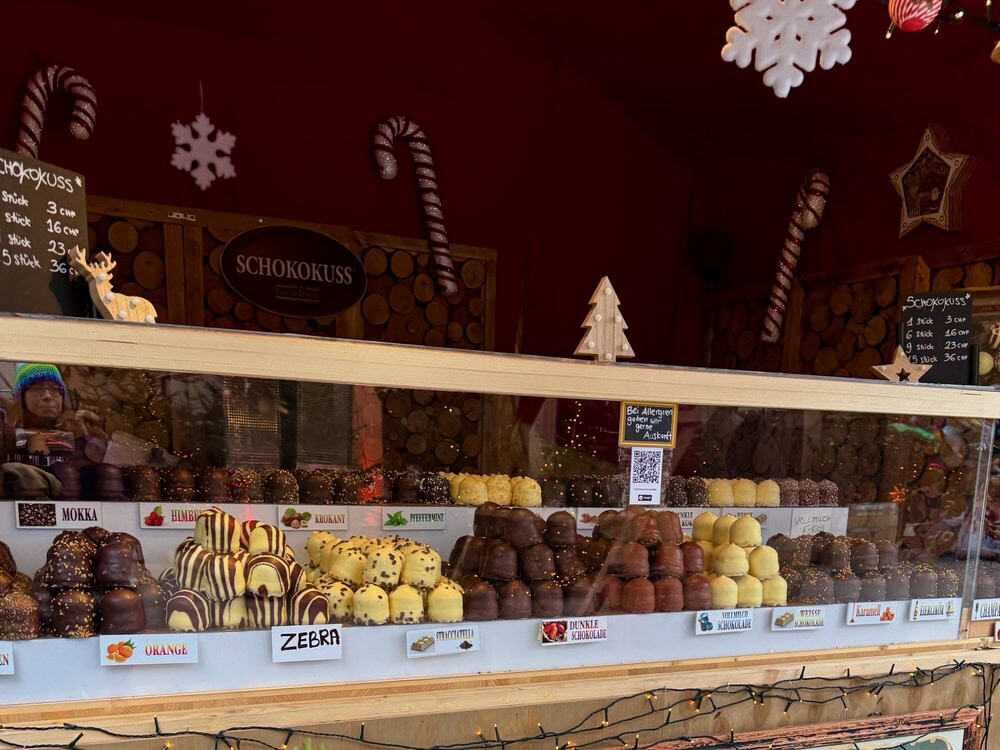
You’ll find stands in the Christmas markets completely devoted to these chocolate covered marshmallow treats. Called either schaumkass or schokokuss, these feature a wafer base similar to an ice cream cone topped with a mound of flavored marshmallow fluff encased in a thin chocolate coating
I wanted to love them, but I was definitely expecting something more like a Pinwheel cookie where the marshmallow has a bit of heft. Instead, this was like sinking your teeth into a chocolate coated pile of marshmallow fluff. The absolute lack of texture was disconcerting.
While they weren’t for me, they’re a great Christmas market buy because they’re quite cheap and come in countless flavors like orange, cinnamon, mint, double chocolate, amaretto, and zebra.If you have enough room in your suitcase, bring a few home for folks to sample during your holiday gatherings.
19) Pain d’epices
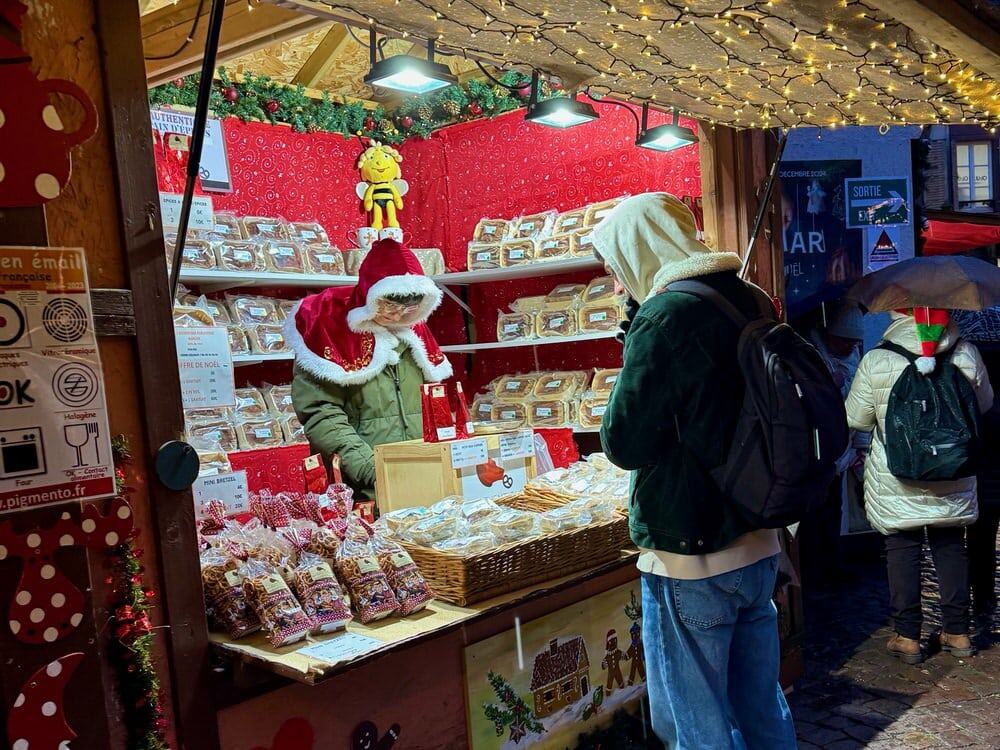
At first glance, this spiced quick bread looks like the French equivalent of gingerbread. However, this favorite French Christmas treat from the Alsace region is definitely more bread than cake. Made with rye or buckwheat flour and traditionally sweetened with honey, you can buy a slice to enjoy at the market, but it’s more common to buy a loaf to take home to eat with either jam or cheese.
20) Dampfnudel
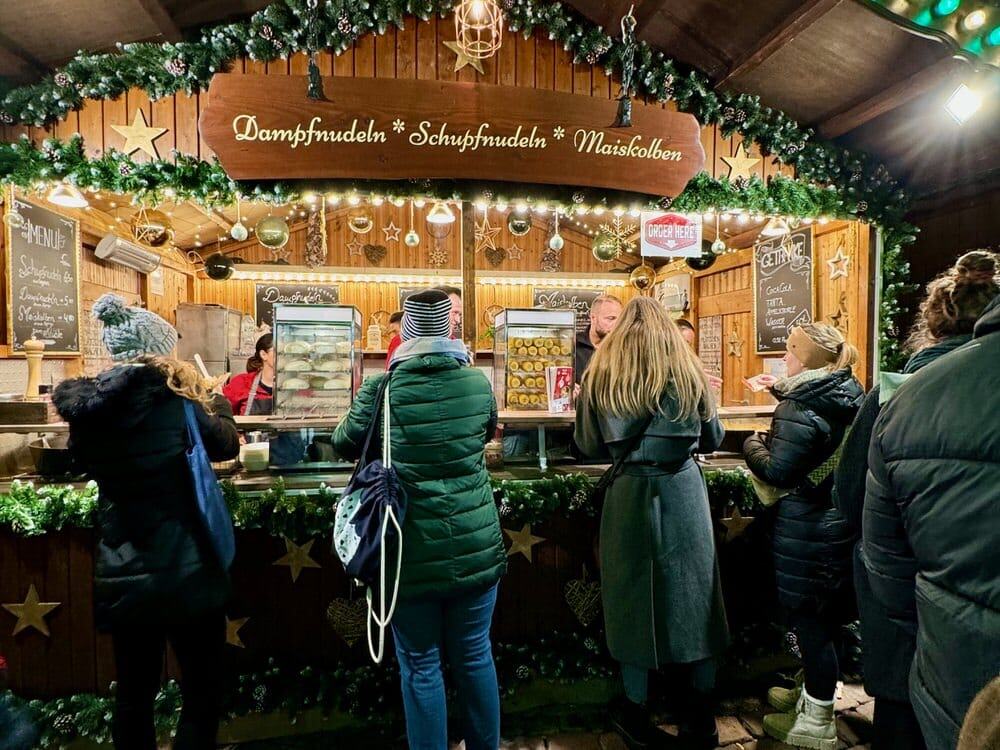
This steamed yeasted dumpling is a favorite in Germany, Austria, Switzerland, and France’s Alsace region. While these can be savory or sweet, these massive softball sized dumplings are often served as a sweet treat at the Christmas markets. They usually have a poppy seed filling and are served drizzled with a warm vanilla sauce. They can also be filled or topped jam or fruit.
Conclusion: Eating Your Way Through Western Europe’s Christmas Markets
No question about it, the Christmas markets in France, Switzerland, and Germany are delicious destinations! Whether you’re looking for a tasty snack or dinner while visiting the market, there’s an almost dizzying amount of tasty options.
You can’t go wrong with classic Christmas market treats like gluhwein, bratwursts, and raclette. However, you’ll also want to try other traditional market foods like schupfnudeln (potato dumplings with sauerkraut and ham), opfelchuechli (fried apple rings with vanilla sauce and cinnamon sugar), and feuerzangenbowle (gluhwein topped with a flaming rum-soaked sugar cube.)
While you might not be super excited about Christmas market foods like churros, corn on the cob, and pretzels that are also common at American state fairs and carnivals, there’s truly something for even the pickiest eater. Some of the market foods like pain d’epices, lebkuchen, and schokokuss even travel well and make excellent holiday gifts.
I hope this guide to favorite European Christmas market foods helps make your visit to these special holiday events extra yummy and memorable. Happy holidays and happy eating!
 |
 |